
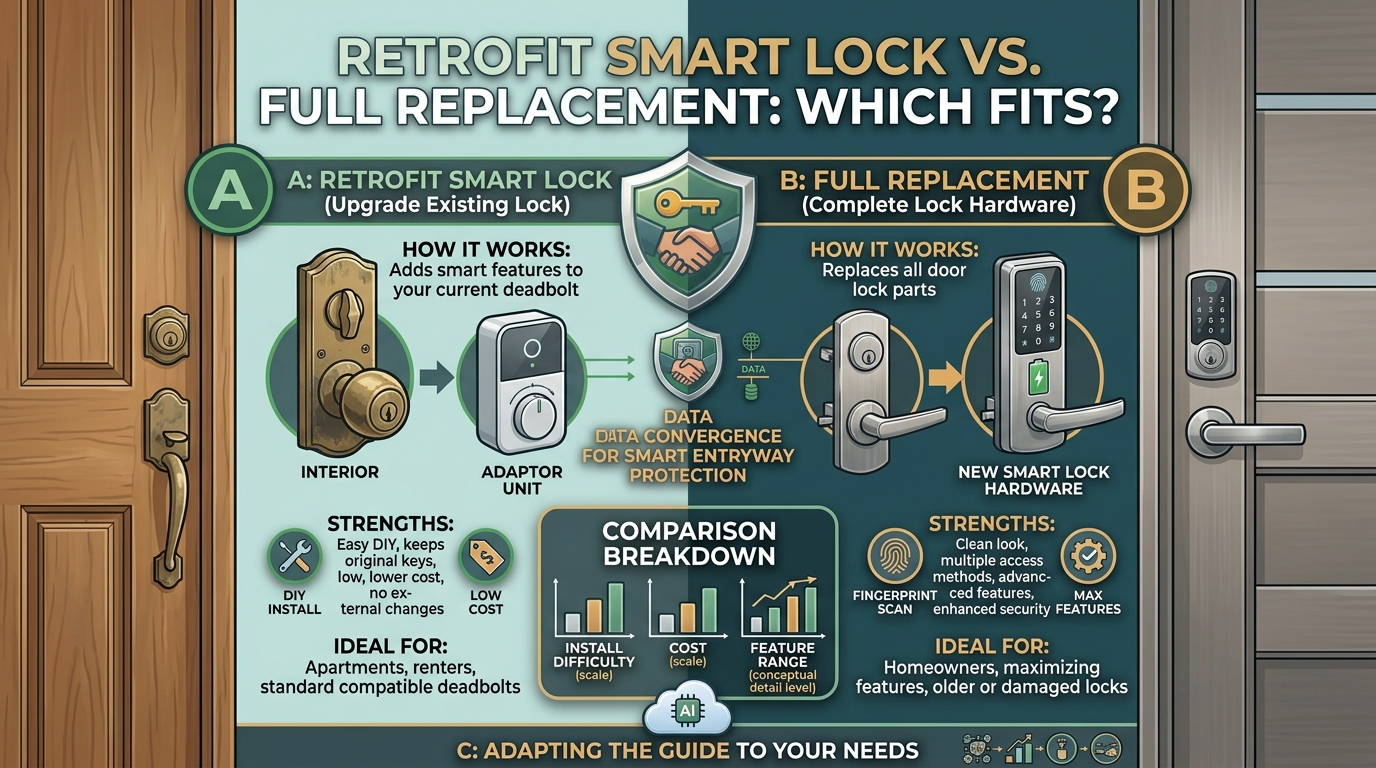
A retrofit smart lock attaches to the inside thumbturn of your existing deadbolt and motorizes it, leaving the exterior keyhole, cylinder, and your physical keys completely untouched. A full replacement removes the entire lock, interior and exterior, and installs a new integrated unit, which usually means your old keys stop working. The two solve different problems: retrofit answers "can I add smart control without changing my door," and full replacement answers "am I ready to redesign the lock itself." This guide covers how to tell which one actually fits your door, not which one is more secure, since that's a separate question this site answers on its own.
This is a hardware-fit question, not a security-grade question
It's easy to fold "retrofit vs replacement" into "which is more secure," but that's a different decision with a different answer. Lock strength depends on grade, strike plate reinforcement, and door and frame condition, and that's true whether you retrofit or fully replace. If you're weighing smart locks against physical security specifically, our comparison of smart lock vs deadbolt security covers that question on its own terms. This guide is narrower: given the lock you already have, does a retrofit device fit it, or do you need a new lock entirely?
What a retrofit smart lock actually changes
A retrofit device sits on the inside of your door, over your existing deadbolt's thumbturn, and turns it electronically in response to an app, a code, or an automatic trigger like your phone approaching the door. Because it only touches the interior side:
- Your existing exterior cylinder and keys keep working. A guest, a house sitter, or a locksmith can still use a physical key exactly as before.
- The outside of your door looks unchanged. This matters for anyone who cares about appearance or, for renters, about the visible modification to a door they don't own.
- Installation is usually a self-install job. Most retrofit locks are designed to attach without removing the existing hardware, so this sits squarely in the DIY category described in our guide to DIY vs professional security installation.
- Compatibility is not universal. Retrofit locks are built to fit standard single-cylinder deadbolt shapes and thumbturn sizes. An unusual, very old, or non-standard deadbolt may not be a match, which is the main reason to check compatibility before buying rather than after.
What a full replacement actually changes
A full replacement swaps the entire lock assembly, inside and out, for a new integrated smart deadbolt:
- The exterior changes. A new keypad, touchscreen, or fingerprint reader replaces the old exterior cylinder, and in many cases a physical key either goes away or becomes a different key than the one you had.
- You get access methods a retrofit can't add, like a keypad code entered from outside without a phone, since the whole exterior unit is new.
- Installation is more involved. You're removing an entire lock rather than attaching a device to one, which usually means a longer install and closer attention to whether the new unit fits your existing door prep (the holes already cut for the old lock).
- It's a bigger commitment, especially for a rented property, since it changes the door's exterior hardware and typically requires giving the landlord a way in or restoring the original lock before move-out.
The renter question, briefly
If you don't own the door, this decision mostly makes itself: a retrofit device that leaves the exterior cylinder untouched is almost always the workable option, and a full replacement usually is not, since most leases don't allow permanently changing a door's exterior lock. Our dedicated guide to smart locks for renters covers that lease question in more depth, including what landlords typically expect access to.
How to decide, in order
- Check whether you rent or own. If you rent, start with retrofit and check your lease before buying anything, full stop.
- Check your existing deadbolt's compatibility against the retrofit device you're considering. Manufacturers publish compatible lock lists; a mismatch here is the most common reason a retrofit installation fails.
- Decide whether you need keypad or fingerprint entry from outside. If yes, only a full replacement adds that, since a retrofit device only motorizes the inside.
- Weigh installation effort against what you're solving for. If the goal is simply "let me lock and unlock remotely, and give temporary access without a spare key," a retrofit device solves that with the least disruption. If the goal includes replacing an aging or poorly rated lock, a full replacement lets you upgrade lock grade and smart control at the same time.
- Confirm your door and frame condition either way. Neither option compensates for a weak strike plate or a poorly fitted frame, and it's worth checking that separately from the smart-vs-not decision.
Maintenance is similar either way
Both categories run on batteries and need occasional firmware updates through their app, so neither one removes that ongoing responsibility. Both send low-battery warnings well ahead of time in most cases, but a dead battery on either type is a real inconvenience worth planning around, particularly on a front door you rely on daily.
FAQ
Can any deadbolt accept a retrofit smart lock? Not always. Retrofit locks are built for standard single-cylinder deadbolt shapes and thumbturn sizes, so check the manufacturer's compatibility list against your existing lock before buying. A non-standard or unusually old deadbolt may not be a fit, in which case a full replacement is the more realistic path.
Do I lose my physical keys with a retrofit lock? No. A retrofit lock only motorizes the interior thumbturn, so the exterior cylinder and your existing keys keep working exactly as before.
Is a full replacement more secure than a retrofit lock? Not automatically. Physical security depends on lock grade, strike plate reinforcement, and door and frame condition, not on whether the lock is retrofit or fully replaced. See our smart lock vs deadbolt guide for that comparison specifically.
Which one should a renter choose? Almost always a retrofit device, since it leaves the exterior cylinder and the door itself untouched. A full replacement changes the door's exterior hardware, which most leases don't allow without the landlord's approval. Our renters guide covers this in more detail.
Can I install either type myself? Retrofit locks are generally designed for self-installation with basic tools. Full replacements are also commonly self-installed, but the job is more involved since you're removing the entire existing lock rather than attaching a device to it; if your door prep doesn't match the new unit's requirements, that's a reasonable point to bring in a locksmith.

I’m John Smith, the founder of Homegadgetguru.com. I use my IT background to extensively test home automation setups in my own house, giving you the hands-on, practical advice you need to build a smarter, more connected home.