
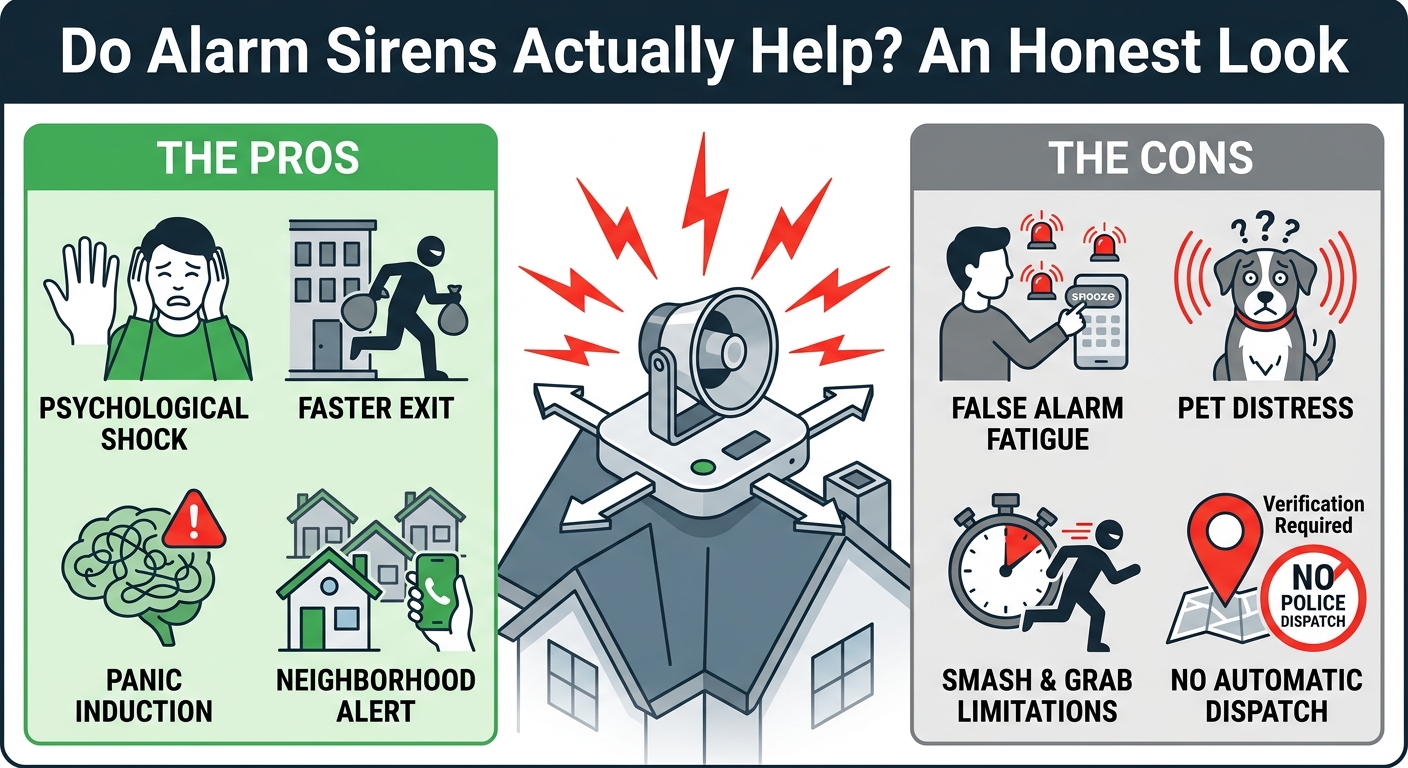
A siren does two things reliably: it interrupts an intruder who was counting on being unnoticed, and it alerts anyone within earshot, including you and your neighbors, that something is happening. What it does not reliably do is guarantee an intruder leaves, guarantee anyone responds, or work at all if nobody is close enough to hear it. The honest answer is that the evidence on deterrence is genuinely mixed, comes mostly from small studies, industry surveys, and vendor-funded sources rather than large independent research, and no credible source publishes a precise, verifiable deterrence percentage worth repeating here. This guide covers what a siren realistically does and doesn't do, and the false-alarm and neighbor costs that are easier to document than the deterrence question itself.
What a siren is actually built to do
A siren's job is narrower than "stop a burglary." It's designed to:
- Interrupt the moment. A sudden loud noise disrupts an intruder's plan, particularly one counting on a quiet, unnoticed entry. Whether that interruption ends the attempt depends heavily on the individual situation, not on the siren alone.
- Alert people who can hear it. That includes you, if you're home, and anyone nearby, including neighbors, who might notice and respond or at least take note of activity at your house.
- Signal that a system exists. A siren that goes off, even briefly, tells anyone paying attention that the house has an active alarm, which is a different kind of signal than a quiet, silently-monitored system provides.
What a siren does not do
- It does not guarantee a response. A siren-only system, without professional or self-monitoring behind it, relies entirely on someone hearing it and choosing to act. If nobody is home, nobody is close enough to hear it, or neighbors assume it's a false alarm and ignore it, as false alarms make more likely over time, the siren's practical effect is limited to whatever deterrent value the noise itself provides in the moment.
- It does not stop a determined intruder. For someone specifically targeting a property regardless of the risk, a siren is a nuisance to work around, not a barrier.
- It is not a substitute for monitoring. A siren tells the neighborhood something is happening; it doesn't dispatch help on its own. If you want an actual response, that requires either professional monitoring or a household member who is home and able to act, which is a separate decision covered in our comparison of self-monitoring vs professional monitoring.
Why we won't publish a deterrence number
Search results for this topic are full of specific-sounding claims, like a fixed percentage of burglars who supposedly avoid homes with an alarm, that trace back to informal industry surveys, older small-sample studies, or sources that don't name a traceable original methodology. Repeating a precise percentage without a source you can actually check isn't more helpful than being honest about the uncertainty, and this site's standing policy is not to publish a number it can't attribute to a named, checkable source. If you see a specific deterrence percentage elsewhere, it's worth asking where it came from before treating it as settled. For a fuller look at what's actually documented about camera and alarm deterrence broadly, our guide to whether security cameras deter burglars covers the strongest and weakest parts of that evidence in more depth; the honest conclusion there applies to sirens as well: real deterrent effect likely exists as one factor among several, but it isn't the kind of effect that supports a clean, quotable statistic.
The cost side nobody markets: false alarms and neighbor fatigue
The clearest, most documentable downside of a siren isn't deterrence failure, it's what happens when the siren goes off for no real reason, which is common with pet motion, wind, wildlife, or a door or window sensor that wasn't set correctly.
- Neighbor fatigue is real. A siren that fires repeatedly for false reasons trains the people around you to ignore it, which undermines the exact alert function the siren exists for. This is the same alert-fatigue problem covered in our guide to cutting security camera false motion alerts, just with a louder, more disruptive version of the same failure mode.
- Many municipalities fine repeat false alarms. A number of local governments in the US require an alarm permit and issue escalating fines after a certain number of false dispatches to police or fire, specifically because false alarms consume emergency-response resources. Rules and fine amounts vary widely by city and county, so check your own municipality's alarm ordinance if you're installing a monitored system with police dispatch, rather than assuming your area either does or doesn't have one.
- A poorly tuned system creates its own credibility problem. If your siren fires often enough that you or your neighbors start assuming it's nothing, you've effectively recreated the "nobody responds" problem the siren was supposed to prevent, just from a different cause.
Getting the false-alarm rate down is the highest-leverage fix
Because deterrence value is uncertain and false-alarm cost is concrete, the most useful thing you can do with a siren-equipped system is reduce how often it fires for the wrong reasons. That mostly comes down to correct sensor placement and, if pets are in the house, sensors chosen and mounted with that in mind. Our guide to motion sensors with pets and our broader guide to door and window sensors both cover placement decisions that cut false triggers at the source, which does more for a siren's real-world usefulness than any setting on the siren itself.
A realistic way to think about sirens
Treat a siren as one layer in a system, not the system itself. It's most useful paired with something that actually generates a response, whether that's a monitoring service, a household member who's home, or attentive neighbors who know your alarm is generally reliable because it doesn't cry wolf. On its own, a siren interrupts a moment and makes noise; whether that noise changes the outcome depends on circumstances no article can promise you in advance.
FAQ
Do alarm sirens actually stop burglars? They can interrupt an intrusion in progress and alert anyone nearby, but there's no reliable, independently verified percentage for how often that changes the outcome. The evidence is mixed and mostly comes from small studies and industry sources rather than large independent research, so treat any specific deterrence statistic you see elsewhere with caution and check its source.
Is a loud siren better than a quiet, monitored alarm? They serve different purposes. A siren interrupts the moment and alerts people nearby; monitoring generates an actual response, such as a call to you or a dispatch to police. Many systems use both, since neither one alone covers what the other does.
Can I get fined for a false alarm? In many US municipalities, yes, particularly for monitored systems that dispatch police or fire. A number of local governments require an alarm permit and escalate fines after repeated false alarms, since responding to them consumes emergency resources. Rules and amounts vary widely, so check your specific city or county's alarm ordinance.
Will my siren annoy my neighbors if it goes off by accident? Yes, and repeated false alarms are the most concrete downside of a siren-equipped system. Beyond the immediate annoyance, frequent false alarms make neighbors less likely to take a real alarm seriously, which undermines the alert function a siren is meant to provide.
What's the single best way to make a siren more useful? Reduce false alarms through correct sensor placement, since a siren that only fires for real events keeps its credibility with anyone who might respond to it. See our guides to door and window sensor placement and motion sensors with pets for the specific fixes.

I’m John Smith, the founder of Homegadgetguru.com. I use my IT background to extensively test home automation setups in my own house, giving you the hands-on, practical advice you need to build a smarter, more connected home.