
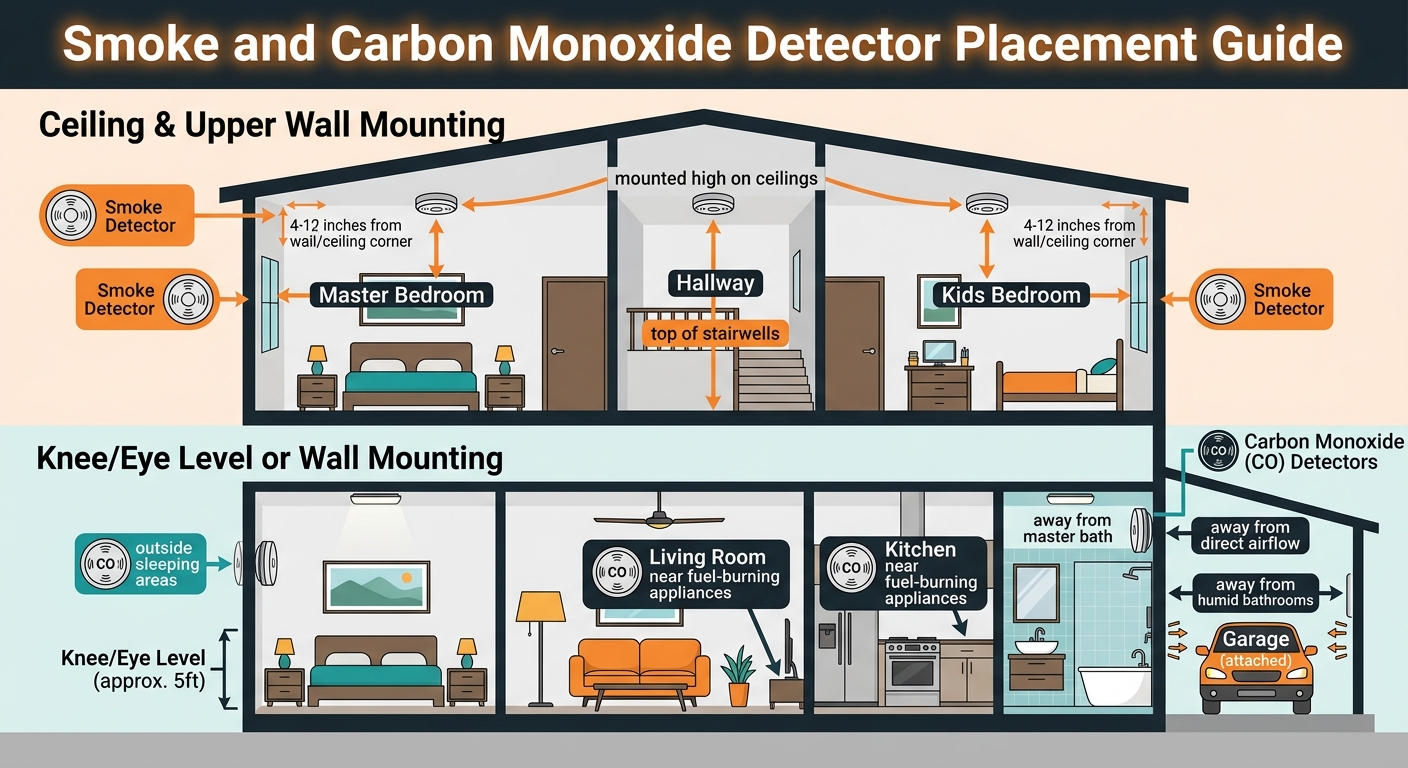
Smoke and carbon monoxide detector placement comes down to a short rule: put a smoke alarm inside every bedroom, in the hallway outside each sleeping area, and on every level of the home, including the basement. Put a carbon monoxide alarm on every level and near sleeping areas too, since CO has no smell, no color, and mixes evenly through room air rather than rising or sinking the way smoke does. Mount smoke alarms on the ceiling or high on a wall, kept a few inches clear of any wall-ceiling corner, and keep both alarm types roughly 10 to 20 feet from cooking appliances, furnaces, and fireplaces to cut down on false alarms. A combination smoke and CO alarm follows the same placement rule as a smoke-only unit.

Smoke and Carbon Monoxide Detector Placement at a Glance
| Location | Smoke alarm | CO alarm | Why |
|---|---|---|---|
| Inside every bedroom | Required | Helpful, not required | A closed bedroom door cuts a hallway alarm's sound roughly in half, which is often not enough to wake a sleeper |
| Hallway outside each sleeping area | Required | Required (at least one per level) | Both smoke and CO travel toward sleeping areas, and this is the choke point |
| Every level, including the basement | Required | Required | Fire and CO sources exist on any floor, not just the one with bedrooms |
| Near, but not directly above, fuel-burning appliances | Keep clear of cooking exhaust | 10 to 20 feet away, per the manufacturer's manual | Startup fumes and cooking steam trigger nuisance false alarms |
| Inside the kitchen itself | Not required | Not applicable | Cooking smoke and heat trip a standard smoke alarm too often to be practical there |
| Bathroom with a shower, or a garage | Avoid | Avoid | Steam, dust, and vehicle exhaust cause repeated false alarms |
Smoke Alarm Placement, Room by Room
Bedrooms. A smoke alarm belongs inside every room where someone sleeps, not just in the hallway outside it. According to the National Fire Protection Association (NFPA, read 2026-09-18), a closed door slows smoke, which is exactly why it also blocks sound: a hallway alarm loses much of its volume behind a closed bedroom door, often not reliably loud enough to wake an adult, let alone a child, from deep sleep. An in-room alarm is what actually does the waking.
Hallways and shared sleeping areas. Place at least one alarm in the hallway or open area immediately outside the bedrooms, close enough that it is genuinely covering the sleeping area rather than a distant end of the house. If a home has a long hallway serving multiple bedrooms, or bedrooms on both ends of a long run, plan on more than one alarm rather than assuming a single unit at one end covers the whole stretch.
Basements, attics, and other levels. Every finished level of a home needs its own smoke alarm, including a finished basement or an attic used as living space. In a basement specifically, mount the alarm near the stairway leading up to the next floor, since that stairwell is the path smoke and heat travel first.
Near the kitchen, but not required inside it. A smoke alarm mounted too close to a stove trips constantly from ordinary cooking, which is the single most common reason a household ends up with a disabled alarm. Keep it back from the cooking area rather than trying to cover the kitchen with a standard smoke alarm at all.
Carbon Monoxide Alarm Placement
CO alarm placement follows a looser height rule than smoke, because carbon monoxide mixes evenly with room air instead of rising like smoke and heat. That means a CO alarm can go on a wall, on a shelf, or plugged into an outlet at any reasonable height and still do its job. What matters more is proximity: keep it back from fuel-burning appliances such as a furnace, water heater, or fireplace, and away from an attached garage door, since a car's exhaust on startup can trigger a nuisance alarm.
The Consumer Product Safety Commission (CPSC, read 2026-09-18) recommends a CO alarm on every level of a home and in the hallway outside each separate sleeping area, and notes that if a household is only installing one, it should go near the sleeping area, where it can wake someone at night. A CO alarm should never be treated as a substitute for a smoke alarm, or the reverse; they detect different hazards and both matter.
Mounting Height and Spots That Cause False Alarms
For smoke alarms, ceiling mounting is the standard recommendation, kept a short distance clear of the corner where the wall meets the ceiling, since that corner traps a small pocket of still air that smoke reaches last. A wall-mounted alarm should sit close to the ceiling rather than partway down the wall. On a sloped or peaked ceiling, mount it near the peak rather than lower on the slope.
Avoid a few locations regardless of alarm type: a bathroom with a shower, where steam sets it off; a garage, where dust and vehicle exhaust do the same; and any spot with poor airflow, such as inside a closet or behind a door where it swings open. Nothing should cover the unit's sensor face, including decorations or a light fixture placed too close.
What You Can Install Yourself, and Where That Stops
A battery-powered or plug-in smoke and CO alarm is a reasonable do-it-yourself project for most homeowners. Mounting the bracket with the screws and drywall anchors included in the box, pairing it with a companion app if it has one, and testing it monthly by pressing the test button does not require touching household wiring. If you are mounting into an unfamiliar wall, a shallow surface-mount anchor is normally all that is needed; there is no reason to drill deep pilot holes near a spot where you cannot see what runs behind the drywall.
A hardwired smoke or CO alarm, wired directly into the home's electrical circuit, is a different job. That work ties into household wiring, and interconnecting several hardwired units so that one alarm triggers all the others runs through that same circuit. This is where DIY installation should stop: call a licensed electrician for any hardwired alarm installation, replacement, or expansion of an interconnected loop. The placement guidance above applies the same way to a hardwired unit; only the wiring work itself belongs to a professional.
Smart Alerts: What a Connected Alarm Adds, and What It Doesn't
A connected smoke or CO alarm sends a phone notification when it triggers, which is useful if nobody is home, but it only helps if someone is actually watching the app or has it set up to reach a monitoring service. That's the same trade-off covered in this site's comparison of self-monitored versus professionally monitored security: a phone alert that nobody sees in time isn't meaningfully different from no alert at all, and a monitoring service that can call for help closes that gap at the cost of a recurring fee and a third party having visibility into the alert.
Placement decisions can also shift for households that include an older adult or anyone with limited mobility or hearing; this site's guide to smart home safety for aging parents covers the wider set of considerations, and the same logic applies to a hazard alarm: a strobe light accessory or an extra alarm closer to where someone actually sleeps can matter more than strict code-minimum placement. If a household is building out a broader plan rather than adding one device at a time, this site's smart home security guide for beginners covers how hazard alarms fit alongside cameras, locks, and sensors as one layer of a full setup.
One placement fact worth planning around: a connected alarm's app notification depends on your home network and, usually, a battery or backup power source inside the unit itself. This site's look at what happens to smart devices during a power or internet outage applies here too, and it's a good reason to keep at least one battery-powered, non-connected smoke and CO alarm in the mix rather than relying entirely on a single connected unit that depends on Wi-Fi to alert anyone.
The Trade-off Nobody Selling These Mentions
The placement mistake that causes real harm usually isn't a slightly wrong mounting height or a few inches off from the ideal corner distance. It's a disabled alarm. An alarm mounted too close to a kitchen or a steamy bathroom nuisance-trips often enough that someone eventually pulls the battery to make it stop, and it's common for that alarm to stay silent for months afterward because putting the battery back in means going back to the same nuisance-tripping spot. The real fix isn't a smarter or more expensive alarm; it's placing it far enough from cooking smoke and shower steam in the first place, which is exactly what the distance guidance in this article is for. A code-perfect placement plan that gets disabled within a month protects nobody.
FAQ
How many smoke alarms does a typical home need? It depends on the layout, but the NFPA-style minimum is one per level, one inside every bedroom, and one in the hallway outside each sleeping area. A two-story, three-bedroom home works out to roughly six alarms at minimum under that formula: one on each level plus three bedrooms and a hallway unit.
Should I get separate smoke and CO alarms or a combination unit? Either works. A combination smoke and CO alarm follows the same placement rule as a standalone smoke alarm, and it means one less unit to mount and test. Separate units give you more flexibility if you want CO coverage in a spot that doesn't need smoke coverage, such as near a furnace.
Does a CO alarm need to be mounted high like a smoke alarm? No. Carbon monoxide mixes evenly through room air rather than rising, so a CO alarm can be wall-mounted at any convenient height or plugged into an outlet. Keep it away from fuel-burning appliances and an attached garage regardless of height.
Can I install these myself, or do I need an electrician? A battery-powered or plug-in alarm is a straightforward DIY install: mount it, pair it with an app if it has one, and test it monthly. A hardwired alarm, or interconnecting several hardwired units, involves the home's electrical circuit and is a job for a licensed electrician.
How often do these need to be replaced, not just have the battery changed? Check the manufacture date stamped on the back of the unit and follow the manufacturer's replacement interval printed there, since it varies by alarm type and model rather than being a single fixed number. Testing monthly and changing batteries on schedule doesn't replace the alarm itself once it reaches that date.

I’m John Smith, the founder of Homegadgetguru.com. I use my IT background to extensively test home automation setups in my own house, giving you the hands-on, practical advice you need to build a smarter, more connected home.