
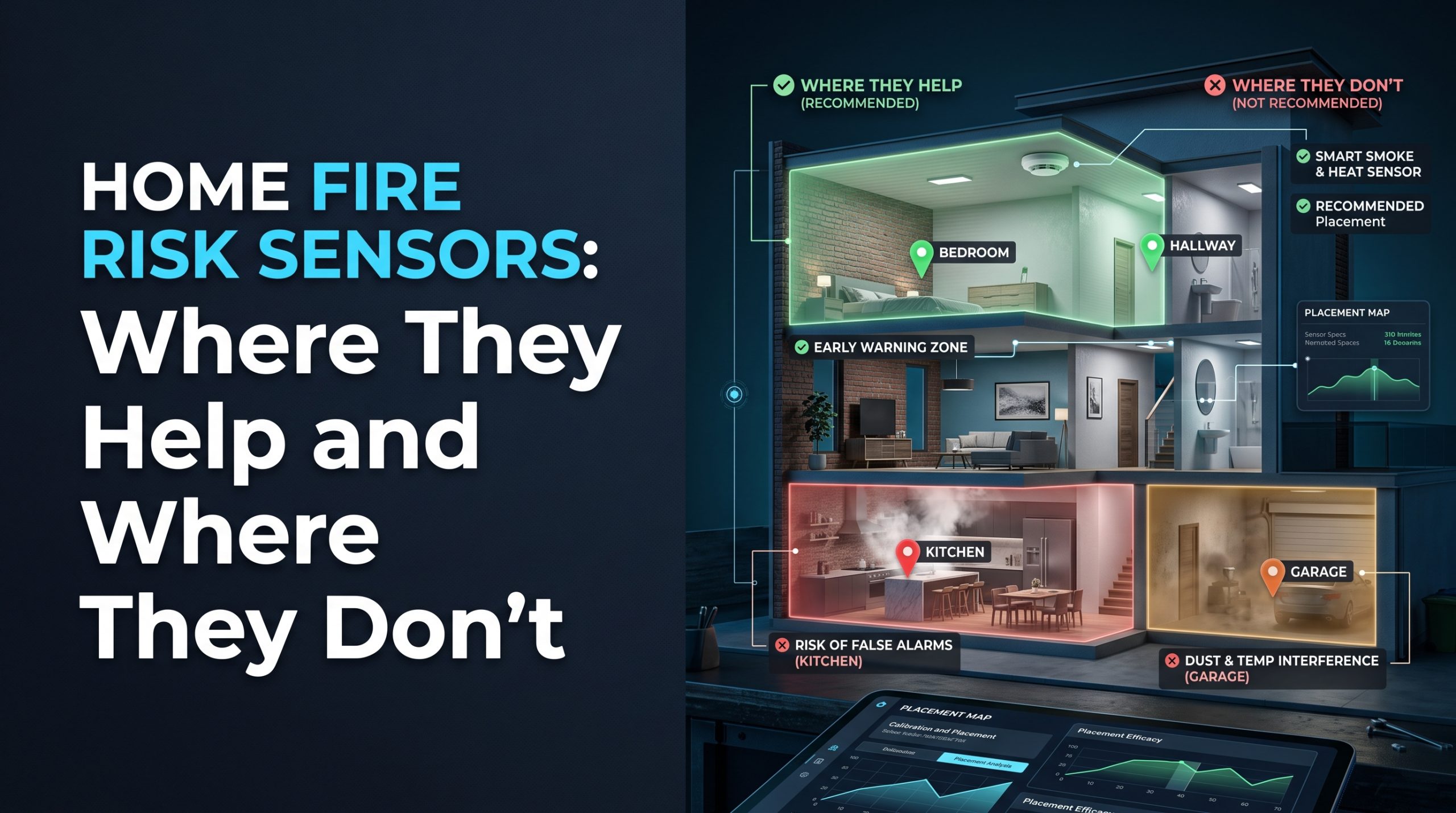
Short answer: Home fire risk sensors, meaning smoke alarms, heat alarms and connected alerts, tell you a fire has started. They do not stop the two everyday habits behind many home fires: lint left to build up in a dryer and a space heater left running too close to something that burns. For those, the protection is the habit itself: a clean lint path, three feet of clear space, and a heater that is off when nobody is watching. Sensors are the backup layer, not the fix. This guide shows where each one helps and where it cannot.
That distinction matters because it is tempting to buy a gadget for a problem that is really about routine. A sensor can shorten the time between a fire starting and you knowing about it. It cannot make a clogged vent safe.
What home fire risk sensors can and cannot do
| Sensor or device | What it can catch | What it cannot do |
|---|---|---|
| Smoke alarm | Smoke from a fire that has already started | Warn you that a vent is clogging or a heater is too close to a curtain |
| Heat alarm (sometimes used in spaces like garages where smoke alarms are prone to nuisance alarms) | A rapid or high temperature rise from a fire | Detect smoldering early, or replace a smoke alarm in living areas |
| Smart alert or listener device | Sends a phone notification when an alarm sounds | Put out a fire, or reach you if the network is down |
| Carbon monoxide alarm | CO from fuel-burning appliances | Detect smoke or fire |
| Your own routine | Lint cleaned, heater placed and switched off correctly | Nothing on this list replaces it |
Read the right-hand column carefully. Almost every entry is "after the fact." That is the honest limit of sensors for fire risk: they are about detection and response, not prevention.
Dryer vents: why the warning sign is easy to miss
The U.S. Consumer Product Safety Commission studied this directly. Its 1999 report on electric and gas clothes dryers (read on 2026-09-27) found that in the fire investigations where the origin was stated, the duct or venting system was the most frequently reported location, followed by the lint trap.
The same report explains why lint build-up is hard to notice. When CPSC engineers blocked the lint screen and exhaust in test dryers, temperatures inside the heater box and drum climbed, but the temperature at the exhaust actually went down, because less hot air was getting out. The report concludes that "the dryer continues to function without any warning to the user (other than ineffective drying of the clothes)," and that the resulting heat can stress electrical parts over time, "setting the stage for a failure to occur and start a fire."
Two useful points come out of that research for anyone thinking about sensors:
- A sensor on the outside vent can be misleading. If the exhaust gets cooler as the problem gets worse, a simple "is the vent hot?" check does not tell you what you think it does. What you would want to know is whether air is flowing freely, not whether it is hot.
- Your clothes are the most reliable early sensor you have. CPSC observed that clothes stayed damp at the end of the cycle once airflow was blocked. If loads that used to dry in one cycle now need two, treat that as the warning.
The report also noted that a "lint alert" feature on the tested electric dryer did not sound during their lint build-up tests, and CPSC staff recommended that dryers include systems that shut down when airflow is obstructed. That was written in 1999 and dryer features have moved on since, so check your own dryer's manual for what its sensors actually do. The broader lesson still holds: do not assume a built-in alert has you covered.
What to do about dryer fire risk
- Clean the lint screen every load. It takes seconds and is the one step fully in your hands.
- Watch drying times. Longer cycles and damp loads point to restricted airflow.
- Check the outside vent flap while the dryer runs. You should feel air coming out and see the flap open.
- Avoid running the dryer when nobody is home or everyone is asleep. If something goes wrong, you want someone there to hear the alarm.
- Make sure a smoke alarm will be heard from the laundry area, following the placement guidance for your home, so a fire there is noticed quickly.
Where DIY stops with dryers
Cleaning the lint screen and checking the outside flap are homeowner tasks. Some jobs are not:
- Gas dryers. Disconnecting or reconnecting a gas dryer involves the gas supply line. Stop there: that is work for a licensed plumber or gas fitter, or the appliance installer.
- Electric dryers. CPSC's report notes that an electric dryer's heating element runs on 240 volts. Do not open the cabinet or touch the wiring or outlet; call a qualified appliance technician or licensed electrician.
- Duct runs inside walls or ceilings. Replacing concealed ductwork is a job for a qualified professional. The same CPSC report notes that dryer manufacturers stress installing the transition duct according to their instructions, "using the recommended rigid metal ducts by qualified technicians."
For more on where homeowner work ends across home safety devices, see our guide on DIY vs professional installation.
Space heaters: the risk is placement and supervision
Space heater fire risk is mostly about what is near the heater and whether anyone is watching it. CPSC's March 2026 winter safety tips (read on 2026-09-27) set out the basics plainly:
- "Keep all sides of the portable heater at least three feet from beds, clothes, curtains, papers, sofas and other items that can catch fire."
- "NEVER leave a portable heater running unattended in a confined space."
- "When using electric portable heaters, ALWAYS use a wall outlet; NEVER a power strip."
- "NEVER run the heater's cord under rugs or carpeting."
No sensor measures "three feet from the curtain." No sensor knows a blanket slid off the bed toward the heater overnight. These are habit problems, and a sensor can only tell you after the habit has failed.
Carbon monoxide comes first with fuel-burning heaters
If your heater burns fuel, such as propane or kerosene, it is a combustion appliance, and combustion is how carbon monoxide gets into a home. Follow the heater manual's ventilation instructions exactly, and have working CO alarms before you use it. CPSC's winter guidance says to "install battery-operated alarms or alarms with battery backup on each level of the home and outside separate sleeping areas," and adds that "interconnected CO alarms are best; when one sounds, they all sound." Gas-line connections for any fixed heater are work for a licensed professional, not a homeowner.
Why we do not suggest a smart plug for a space heater
It is tempting to put a space heater on a smart plug so you can switch it off from your phone. We do not recommend that as a default. CPSC's rule is a wall outlet, never a power strip, and a smart plug adds another connection between the heater and the wall. Unless both the heater's manual and the smart plug's own specifications explicitly allow it, plug the heater straight into the wall and switch it off by hand when you leave the room. Remote control does not fix the core risk anyway: a heater running in a room with nobody in it.
Where sensors genuinely help with fire risk
Sensors are not the fix for habits, but they do real work in three situations.
When nobody is home
A smoke alarm in an empty house sounds with nobody to respond. A connected alarm or listener device sends that alert to your phone. This matters most if you travel or have pets home alone. Our checklist for leaving home for a week covers what else to switch off and check before you go.
When someone at home may not react
An older parent who lives alone, a heavy sleeper, or someone with hearing loss may not respond to a standard alarm in time. A connected alarm that also alerts a family member elsewhere adds a second chance. Our guide to smart home safety for aging parents covers how to set that up without it becoming intrusive.
When the risky room is out of earshot
A laundry room in the basement or a garage workshop can be far from bedrooms. CPSC says interconnected CO alarms are best because when one sounds, they all sound, and the U.S. Fire Administration gives the same advice for smoke alarms. Interconnection is one of the most practical upgrades for a home where the higher-risk rooms are far from where people sleep. Interconnecting hardwired alarms is work for a licensed electrician; wireless interconnected battery alarms are a homeowner option.
A practical fire-risk routine, sensors included
- Every load: clean the lint screen. Notice if drying takes longer than it used to.
- Every use of a space heater: check three feet of clear space on all sides, plug directly into a wall outlet, and switch it off when you leave the room or go to sleep.
- Monthly: test smoke and CO alarms, as CPSC advises.
- Seasonally: check that the outside dryer vent flap opens and air flows while the dryer runs.
- When the dryer or heater misbehaves: stop using it and call the right professional, rather than adding a sensor to watch a known fault.
Connected alarms sit in a higher price tier than basic alarms. Spend on them where they close a real gap, such as an empty house or a relative who may not hear the alarm, rather than as a substitute for the routine above.
FAQ
Are there sensors that detect a clogged dryer vent?
Some products claim to monitor dryer airflow, and some dryers include built-in alerts. CPSC research found the clearest early sign is often longer drying times and damp clothes, and that exhaust temperature can fall as lint builds up, so treat any single sensor reading with care.
Can home fire risk sensors prevent a fire?
No. Smoke alarms, heat alarms and connected alerts detect a fire that has already started. Prevention comes from habits: cleaning lint, keeping space heaters three feet from anything that burns, and never leaving them unattended.
Is it safe to plug a space heater into a smart plug?
CPSC says to use a wall outlet and never a power strip for electric portable heaters. A smart plug adds a connection between heater and wall, so we suggest plugging straight into the wall unless both manuals explicitly allow a smart plug.
Do I need a smoke alarm in the laundry room?
Placement rules vary by location and home layout. CPSC advises smoke alarms on every level of the home and inside each bedroom. If the laundry area is far from bedrooms, interconnected alarms help make sure a fire there is heard.
Do space heaters need a carbon monoxide alarm?
Any heater that burns fuel is a combustion appliance and a potential CO source. CPSC advises CO alarms on each level of the home and outside separate sleeping areas, with battery power or battery backup.

I’m John Smith, the founder of Homegadgetguru.com. I use my IT background to extensively test home automation setups in my own house, giving you the hands-on, practical advice you need to build a smarter, more connected home.