
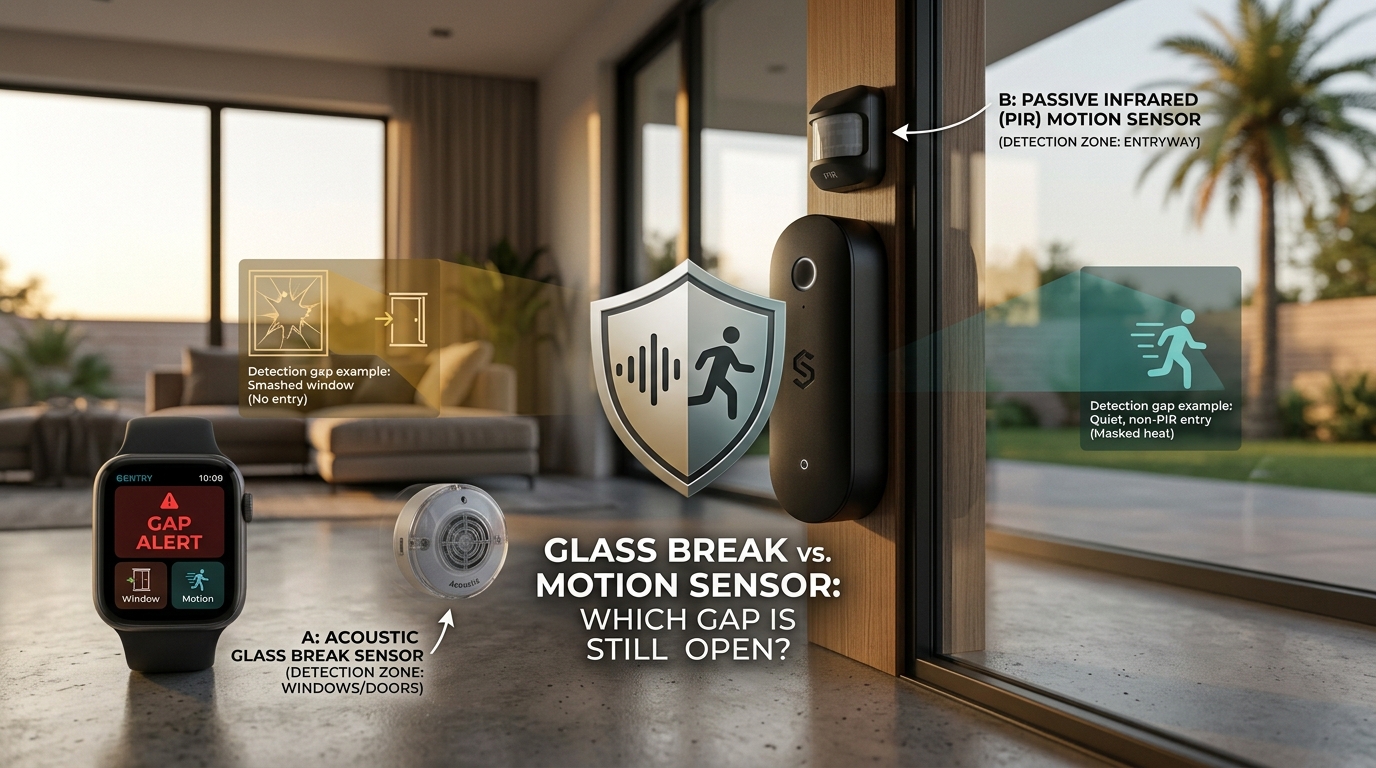
If your doors and windows already have contact sensors covering the entry points, the natural next question is whether a glass break sensor or a motion sensor is the better next addition. The honest answer is that neither is trying to do the same job as the other, and neither replaces the door and window sensor layer you already have. Each closes a specific, real gap that a contact sensor leaves open.
A glass break sensor closes the gap left when a window is broken rather than opened normally, something a magnetic contact sensor cannot detect since the window frame never actually separates. A motion sensor closes the gap left once someone is already inside a room, regardless of how they got there. For most homes already covered by door and window sensors, a motion sensor closes the larger, more common gap for the money. Glass break sensors earn their place on specific vulnerable windows, not as a whole-house default.
How each sensor actually works
A glass break sensor uses a small microphone tuned to recognize the specific acoustic signature of breaking glass, a distinct sound and frequency pattern different from a door slamming or a dropped object. It is a form of perimeter protection, meant to catch an intrusion at the moment of entry, before anyone has actually stepped inside.
A motion sensor works differently, using infrared, microwave, or ultrasonic sensing (or a combination) to detect movement within a room. It is interior protection: it does not care how someone got in, only that something is now moving inside a space it is watching. This is also why motion sensors are typically only armed in "away" mode. Arming them while you are home would mean your own movement constantly triggers the system.
The gap a door and window sensor leaves open
This site's guide to door and window sensors covers why a magnetic contact sensor is worth having: it alerts the moment an entry point opens. But it only detects a door or window opening the way it is designed to, not a window that gets smashed rather than unlatched. A determined break-in through a ground-floor window, bypassing the normal opening mechanism entirely, is exactly the scenario a contact sensor cannot see and a glass break sensor exists to catch.
When glass break coverage is worth adding
Glass break sensors make the most practical sense on specific windows that are large, at ground level, isolated from other coverage, or otherwise an obvious target, rather than as blanket coverage for every window in a home. One sensor can typically cover a room's worth of glass, since it listens for sound rather than needing to be attached to each individual pane, which makes it reasonably efficient to add to the two or three windows that actually warrant it.
When motion sensor coverage is worth adding
A motion sensor is generally the more broadly useful addition for a typical home, because it catches an intruder regardless of the entry method: a door or window a contact sensor missed, an unlocked point of entry, or simply movement in a room while the system is armed away. Placed in a central hallway or main living area, one motion sensor can cover the paths someone would need to cross to reach most of the rest of the home.
Stay mode vs away mode: why this matters more than it sounds
Motion sensors are typically disabled while a system is in "stay" mode, meaning armed while people are home, precisely because household movement would otherwise set them off constantly. This means a motion sensor genuinely only protects you while everyone is out. A glass break sensor, by contrast, can usually stay active even in stay mode, since it is listening for a distinct sound rather than any movement, which makes it useful protection for a specific vulnerable window even while you are home. This distinction is a real, practical reason some households choose both rather than treating them as interchangeable options.
For the broader alert-fatigue question that comes with adding any additional sensor, see this site's guide to reducing security camera false motion alerts, much of which applies to sensor placement generally.
Do you need both, or is one enough for most homes
For most homes already covered by door and window sensors, a single motion sensor covering a central area, active while away, closes the largest remaining gap for the least cost and effort. Glass break sensors are worth adding specifically where a window is both vulnerable and not already well covered by anything else, rather than as a first purchase. Whether a monitored or self-managed system changes this calculus at all is covered in this site's self-monitored vs professionally monitored security guide.
Placement basics for each sensor type
A glass break sensor works best mounted where it has a relatively clear line of "hearing" to the glass it is meant to cover, typically on a wall or ceiling within the same room as the window, rather than in an adjacent hallway where the sound would be muffled by a wall. Manufacturers generally specify an effective range in feet, and a single sensor placed centrally in a room can often cover multiple windows in that same space, which is part of why they do not need to be purchased for every individual pane.
A motion sensor is typically most effective mounted in a corner, angled to cover the width of a room or a hallway someone would need to cross, rather than aimed directly at a single doorway. Placing one near the top of a stairway, in a main hallway, or in the room that connects most of the rest of the home tends to give the broadest coverage from a single unit, since it catches movement regardless of which specific door or window someone entered through.
A realistic starting setup
For a household starting from door and window sensors and adding one more layer, a single motion sensor covering the main hallway or central living space, active while away, is a reasonable and cost-effective next step for most homes. From there, add a glass break sensor only if a specific window genuinely stands out as a weak point: a large ground-floor window with no motion sensor coverage nearby, or a window in a room that sits apart from the rest of the home's traffic pattern. Treating this as an incremental, gap-driven decision, rather than buying every sensor type available, keeps the DIY, no-monthly-fee approach this site favors intact.
FAQ
Do I need a glass break sensor if I have door and window sensors? Only for specific vulnerable windows where a break-in through the glass, rather than through the normal opening mechanism, is a realistic concern. Door and window sensors do not detect broken glass.
Which is better for most homes, glass break or motion sensors? A motion sensor typically closes a larger, more common gap for most homes, since it detects an intruder regardless of how they got in. Glass break sensors are a targeted addition for specific vulnerable windows.
Do motion sensors work while I'm home? Usually not by default. Motion sensors are typically only armed in "away" mode, since normal household movement would otherwise trigger constant false alerts while people are home.
Can one glass break sensor cover multiple windows? Often yes, since it listens for the sound of breaking glass rather than needing a physical connection to each window, one sensor can typically cover a room's worth of glass.
Should I get both a glass break sensor and a motion sensor? Many households do, since each closes a different gap. Start with a motion sensor for the broader coverage, then add glass break sensors for specific windows that remain a concern.

I’m John Smith, the founder of Homegadgetguru.com. I use my IT background to extensively test home automation setups in my own house, giving you the hands-on, practical advice you need to build a smarter, more connected home.