
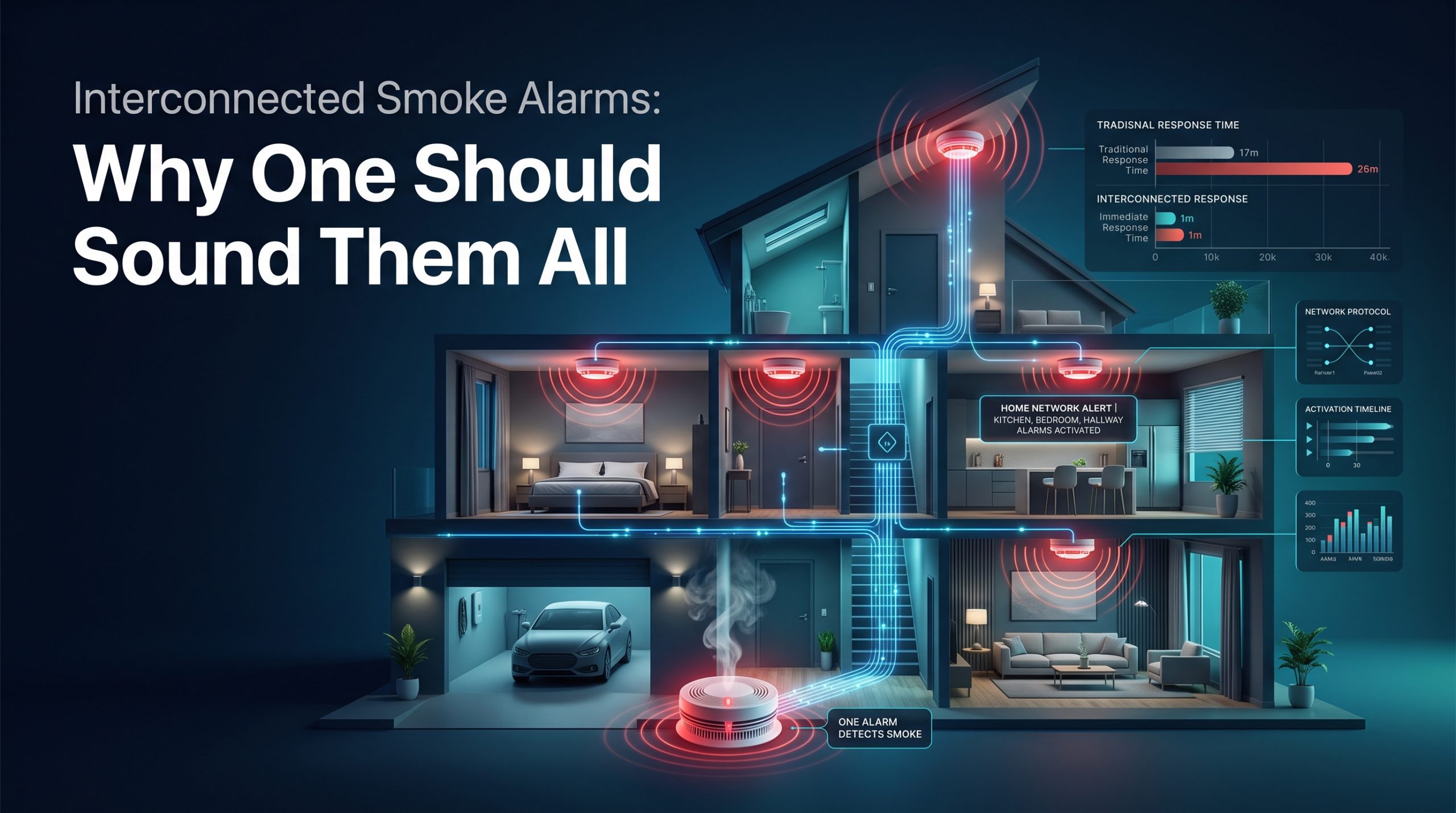
Short answer: interconnected smoke alarms are linked so that when one detects smoke, every alarm in the home sounds. The U.S. Fire Administration advises choosing interconnected alarms for exactly that reason. Without the link, a fire in the basement may set off only the basement alarm, which can be hard to hear from a bedroom with the door closed. Alarms can be linked through household wiring, which is work for a qualified electrician, or with battery-powered wireless alarms you can install yourself. A phone notification is not the same thing.
This guide is independent and brand-neutral. It explains how the link works, where DIY stops, and the one situation where interconnection matters most: a household that sleeps with the bedroom doors closed.
What interconnected smoke alarms actually do
A standalone smoke alarm only sounds when smoke reaches it. In a home with several standalone alarms, a fire in one part of the house sets off the nearest alarm and nothing else until smoke spreads further. Interconnection removes that delay: the first alarm to detect smoke triggers every other alarm in the set.
The U.S. Fire Administration, part of FEMA, puts it in one line on its smoke alarm guidance (read 2026-09-24): "Choose interconnected smoke alarms so that when one sounds, they all sound." The same page makes the reason plain. It says your family is not safe if they cannot hear the smoke alarms, and that when you hear a smoke alarm, you may have less than 2 minutes to get everyone outside and safe.
Put those together and the case is simple. The minutes that matter are the first ones, and interconnection is what makes the first alarm heard in every bedroom rather than only in the room where the fire started.
The closed-door problem nobody connects
Fire-safety researchers urge people to sleep with bedroom doors closed. The Fire Safety Research Institute's Close Before You Doze campaign (read 2026-09-24) states that a closed door can mean the difference between 1,000 degrees and 100 degrees in the event of a fire, and that during a fire a closed door can keep carbon monoxide levels at 1,000 ppm versus 10,000 ppm when the door is left open. The USFA agrees that a closed door may slow the spread of smoke, heat and fire.
That advice is sound, and it raises a second question most alarm guides never ask: if the door is closed, can you hear an alarm on the other side of it? A closed door that holds back smoke also sits between a sleeping person and an alarm in the hallway or the basement.
The USFA's placement guidance answers it. It says to put smoke alarms inside and outside each bedroom and sleeping area, and on every level of the home. With interconnection, the alarm inside the closed bedroom sounds the moment the basement alarm detects smoke. Closing the door and linking the alarms are not competing pieces of advice. They are two halves of the same plan.
Three ways alarms get linked
| Type | How the alarms talk | Power | Who installs it |
|---|---|---|---|
| Hardwired interconnect | Through the home's electrical wiring | Household power, typically with a backup battery | A qualified electrician |
| Wireless interconnect | Radio signals between the alarms themselves, no new wiring | Batteries, replaceable or sealed long-life | You, following the manual |
| Connected (smart) alarms | The maker's own wireless link, plus an app | Battery or hardwired, depending on model | Depends on the power type |
Kidde, a smoke alarm manufacturer, describes the first two on its page about why interconnected alarms matter (read 2026-09-24). Wired alarms are physically connected through your home's electrical wiring and typically include a backup battery for power outages. Wireless alarms communicate through radio frequency signals, creating an in-home network without the need to run new wiring.
For a home without interconnect wiring, wireless interconnect is the practical route, because it adds the link without opening a wall or ceiling. The USFA notes that battery alarms come with either replaceable batteries or nonreplaceable 10-year batteries, so check which type a set uses before you buy.
A phone alert is not interconnection
Connected alarms and some smart home devices can send a notification to your phone when an alarm sounds. That is genuinely useful when you are away, because it tells you something is wrong at home. It is not a substitute for interconnection at night.
A notification reaches whoever holds the phone, and only if the phone is charged, nearby, not silenced, and the home network and internet are up. Interconnection sounds in every room that has an alarm, whether anyone's phone is working or not. The Wi-Fi dependency is the same one covered in our guide to how connected devices like security cameras behave in a power or internet outage.
Sound as a safety tool also comes up in our honest look at whether alarm sirens help with security systems. For fire, the answer is clear: if an alarm is going to wake a sleeping household, it has to sound where they sleep.
Mixing brands and models: where the chain breaks
Interconnection is not universal. Kidde's page states it directly: not all alarms can connect to each other, and even within the same brand, compatibility can vary depending on model type and technology. It advises confirming which specific models can interconnect before buying, using the manufacturer's user guides and compatibility guides.
In practice, that means three things:
- Buy a linked set from one compatible product line, and confirm compatibility in the manufacturer's own guide rather than on a retail listing.
- When one unit in a linked set fails or expires, replace it with a model the manufacturer lists as compatible. A mismatched replacement can look fine on the ceiling and never sound with the others.
- Replace the set on one schedule. The USFA says to get new smoke alarms every 10 years. Replacing a linked set together keeps every unit on the same age and the same compatible line.
Where DIY stops
Battery-powered wireless interconnected alarms are a homeowner job: mount them where the USFA's placement guidance and the manufacturer's manual say, then pair them as the manual describes.
Hardwired alarms are not. The USFA states that only qualified electricians should install hardwired smoke alarms. That covers adding a hardwired alarm, replacing one, and extending or repairing interconnect wiring. If you have hardwired alarms and want the link to reach rooms without wiring, ask the electrician, and check the manufacturer's compatibility guide for an approved way to combine wired and wireless units, if it offers one. Our guide to where DIY security installation should stop explains the same line for other home systems.
Whether your home must have interconnected alarms depends on local code and on when the home was built or renovated. Codes vary by location, so your local fire department or building department is the authority for your address.
Checking the alarms you already have
The USFA says to test alarms monthly and to take care of them according to the manufacturer's instructions. On an interconnected set, the test tells you more than whether one alarm works:
- Press the test button on one alarm and listen for the others. Your manual is the authority on what an interconnected set should do during a test. If the others stay silent when they should sound, the link is missing or broken; for hardwired sets, that is a call to an electrician.
- Do the bedroom check. With a bedroom door closed, have someone test the alarm farthest from that room, and listen from where people actually sleep. This is the practical version of the USFA's point that your family is not safe if they cannot hear the alarms.
- Think about who might not wake. The USFA notes there are alarms for people with hearing loss that may use flashing strobe lights and vibration. If someone in the home has hearing loss or is older and sleeps deeply, factor that into the setup. Our guide to smart home safety for elderly parents covers the wider picture.
One more detail from the same USFA page: ionization and photoelectric smoke alarms detect different types of fires, which is worth knowing when you choose the alarms that go into a linked set.
On cost, think in tiers rather than price tags. Basic wireless interconnected sets cover the core job. Mid-tier sets add features such as sealed long-life batteries or voice alerts. Connected alarms add phone notifications on top of the local link. Every tier should do the one thing that matters: make every alarm sound when one does.
Frequently Asked Questions
What does interconnected mean for smoke alarms?
It means the alarms are linked so that when one detects smoke, all of them sound. The U.S. Fire Administration advises choosing interconnected smoke alarms so that when one sounds, they all sound.
Can I interconnect smoke alarms from different brands?
Usually not. Kidde states that not all alarms can connect to each other, and that even within one brand, compatibility can vary by model type and technology. Check the manufacturer's compatibility guide before buying or replacing a unit.
Do interconnected smoke alarms need Wi-Fi?
The interconnection itself runs through household wiring or the alarms' own radio signals. Phone notifications are the part that relies on your home network, so check the manual for what still works during an internet outage.
Can I install interconnected smoke alarms myself?
Battery-powered wireless models, yes, following the manual. Hardwired alarms are different: the USFA states that only qualified electricians should install hardwired smoke alarms.
How often should interconnected smoke alarms be tested and replaced?
The USFA says to test smoke alarms monthly and to get new smoke alarms every 10 years. On a linked set, the monthly test is also your check that every alarm still sounds together.

I’m John Smith, the founder of Homegadgetguru.com. I use my IT background to extensively test home automation setups in my own house, giving you the hands-on, practical advice you need to build a smarter, more connected home.