
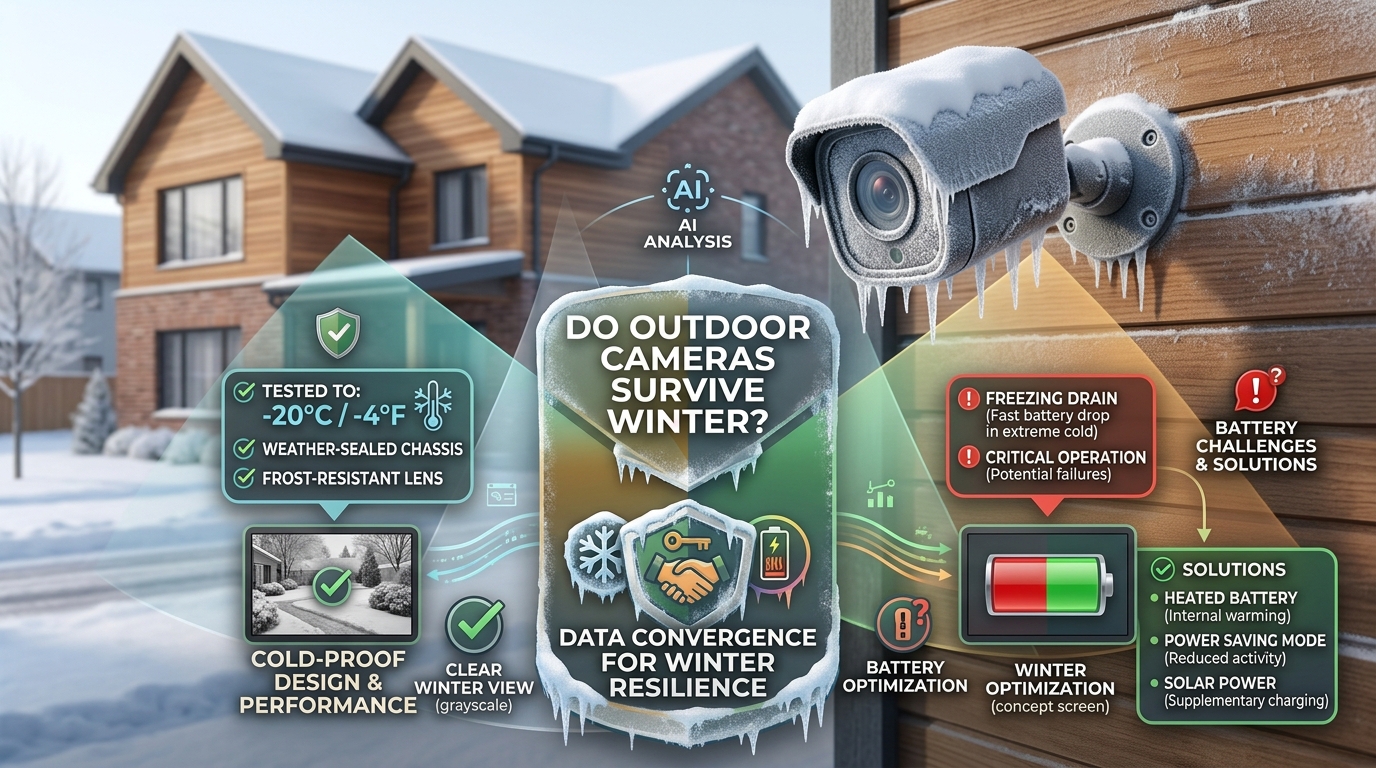
A battery-powered security camera that ran for weeks all summer and suddenly needs charging every few days once winter arrives is not necessarily failing. This is expected behavior for lithium-ion batteries, the type used in almost every wireless security camera, and it happens because cold slows down the chemical reactions that produce the battery's charge, not because the device is broken.
Commonly cited figures put usable capacity loss at 20 to 50 percent in freezing temperatures, and in extreme cold, a battery can lose up to half its normal performance until temperatures rise again. A camera that runs for weeks in mild weather may only last a few days in a hard freeze. The two real fixes are bringing batteries inside to warm up before recharging, and choosing wired power for a spot that sees genuinely harsh winters.
Why cold affects a battery, in plain terms
A lithium-ion battery produces power through a chemical reaction between its internal materials. Cold temperatures slow that reaction down, the same way most chemical processes slow down when they get colder, which means the battery cannot deliver electrons as efficiently as it can at room temperature. This is not specific to any one brand of camera or battery. It is simply what cold does to this battery chemistry, in a security camera, a phone, or anything else built around it.
In a hard freeze, this effect can be dramatic enough that a battery appears to shut off suddenly, even though it still holds some charge, because it can no longer deliver power fast enough to keep the device running.
What this actually looks like: shorter runtime, not necessarily a dead camera
The practical result for most households is a camera that needs far more frequent charging through the coldest months, sometimes a matter of days instead of the weeks it managed in warmer weather. This is inconvenient, but it usually does not mean the camera or the battery has failed. Once temperatures come back up, whether seasonally or because the camera is brought inside, a genuinely healthy battery returns close to its normal runtime.
If a battery no longer recovers its runtime once temperatures warm up, or drains unusually fast even in mild weather, that is a different and more genuine sign of a battery nearing the end of its useful life, separate from the normal cold-weather effect described here.
The mistake that causes real, permanent damage: charging while frozen
The cold-weather runtime drop described above is temporary and expected. Permanent damage is a different, avoidable problem: charging a lithium-ion battery while it is still below freezing can degrade it in a way that does not reverse once it warms back up. If you bring a battery inside specifically to recharge it during a cold spell, it is worth letting it warm to closer to room temperature first, rather than plugging it in the moment it comes indoors.
When wired power is the better answer for a cold climate
This site's wired vs wireless security cameras guide covers the broader tradeoff between the two power types, including installation flexibility and outage behavior. A genuinely cold climate is a specific, additional reason wired power can be worth the extra installation effort: a wired camera has no battery to lose capacity in the first place, so it keeps running at full performance right through the coldest stretch of winter. For a spot with reliable access to power and a climate with long, hard freezes, this is one of the clearer cases where wired makes practical sense.
Practical steps for a battery camera through a hard winter
A few habits reduce how much winter actually costs you in camera uptime. Bring spare batteries inside to store and recharge in normal room temperature rather than leaving a charging dock outdoors. Expect to swap or recharge more often during the coldest weeks and plan around it rather than being surprised by it. If a specific camera location sees the harshest cold on the property, such as an unheated, wind-exposed corner, that location is also the best candidate to consider switching to wired power, per the guidance above, since it will lose the most runtime to cold.
Cold weather is also a good moment to revisit this site's guide on what happens during a power or internet outage, since a battery already stressed by cold combined with a winter storm knocking out power or internet is a realistic scenario worth planning for together, rather than as two separate problems.
Does cold affect image quality too?
Cold weather mainly affects runtime rather than the picture itself, though a few secondary effects are worth knowing. Camera lenses can fog or frost in certain humidity and temperature combinations, temporarily affecting clarity until the condensation clears. Winter also means darkness falls earlier and lasts longer, which puts more emphasis on a camera's night vision performance for a larger share of the day than in summer. Neither of these is really a battery problem, but both are part of what "surviving winter" means for an outdoor camera overall.
What this means for footage gaps
A camera that shuts down mid-winter because its battery ran out of usable charge is not recording during that gap, which matters if the coldest stretch of the year happens to coincide with a period you are relying on that coverage. This is worth planning around specifically rather than discovering it after the fact: check battery levels more often during a cold snap than you would in mild weather, and treat a sudden, unexpected shutdown during a hard freeze as an expected possibility rather than a surprise malfunction to troubleshoot at length.
FAQ
Is it normal for my security camera battery to drain faster in winter? Yes. This is a well-documented effect of cold on lithium-ion batteries, not a sign your camera is defective, and it is common to see a battery last only days instead of weeks during a hard freeze.
Should I bring my camera's battery inside during winter? Yes, if it is removable. Bringing a battery inside to recharge at room temperature, rather than charging it while still cold, avoids the permanent damage that charging below freezing can cause.
Is a wired camera better than a battery camera in a cold climate? For genuinely harsh winters, wired power avoids the battery capacity loss entirely, so it is a reasonable upgrade to consider for the coldest-exposed spot on a property, even if other locations stay on battery power.
Does cold weather damage the camera itself, not just the battery? Most consumer outdoor cameras are rated for a wide temperature range for the camera body itself. The battery is typically the more sensitive component in cold weather, not the camera electronics or housing.
Will my camera's battery recover once it warms up? A healthy battery generally returns close to its normal runtime once temperatures rise. If it does not, or drains unusually fast even in milder weather, that points to the battery reaching the end of its useful life rather than a cold-weather effect.

I’m John Smith, the founder of Homegadgetguru.com. I use my IT background to extensively test home automation setups in my own house, giving you the hands-on, practical advice you need to build a smarter, more connected home.