Short answer: A smart plug can safely run some kitchen appliances, but only if three things are true: the plug is rated for the appliance's load, the appliance is designed to switch on by itself when power arrives, and nobody will be surprised by heat when it does. In practice that makes low-risk items, such as a kitchen lamp, a small fan or a simple drip coffee maker you stay home with, reasonable candidates. Kettles, toasters, toaster ovens, space heaters, and anything with a motor or a heating element that could start with nobody present are the ones to leave on the wall outlet.
Most "never plug this in" lists focus only on wattage. Wattage is one check. It is not the whole picture, and in the kitchen it is often not the most important one.
The three checks for smart plug kitchen appliances
Before you put any kitchen appliance on a smart plug, run it through all three of these. If it fails any one, leave it plugged directly into the wall.
1. The electrical check: can the plug carry it? Every smart plug has a maximum rating printed on it or listed on the maker's specifications page. Every appliance has a wattage or amperage on its label. The appliance must be comfortably below the plug's limit, not just under it.
2. The switching check: will it actually turn on? A smart plug does one thing: it turns the power to the outlet on and off. It does not press buttons. Appliances with a physical switch that stays in the "on" position will start when power arrives. Appliances with electronic buttons often reset to "off" whenever power is cut, so a smart plug cannot start them at all.
3. The attention check: should this be on with nobody watching? This is the one most lists skip. Even if a plug can carry the load and the appliance will start, the question is whether it should. Anything that produces heat, and anything that can start a fire if something is left on or near it, needs a person nearby.
What the plug makers themselves say
It helps to read what a smart plug maker actually specifies, rather than rely on forum rules of thumb.
TP-Link's support page on what loads its Tapo and Kasa plugs can carry (read on 2026-09-27) says the plugs are "designed primarily for resistive loads, such as heaters, kettles, and electric irons" but are "not suitable for high-power inductive loads driven by motors, such as air conditioners, refrigerators, or washing machines." It explains that motor-driven devices "typically generate a high inrush current during startup, which may exceed the plug's rated current."
The same page adds three limits worth knowing:
- For continuous long-term use, "keep the total connected load at 80% or less of the maximum rated power."
- "Power strips are not recommended, as they may create safety risks or cause the total load or surge current to exceed the plug's design limits."
- "Avoid placing your plug in areas exposed to direct sunlight, high temperatures, or enclosed spaces."
Notice what this tells you, and what it does not. A maker saying a plug can electrically carry a kettle is a statement about the plug's rating. It is not a statement that switching a kettle on remotely is a good idea. That is the attention check, and no plug specification answers it for you. Always read the appliance's own manual too: if it says to plug the appliance straight into a wall outlet, that instruction wins.
Why the attention check matters most in a kitchen
Kitchens are where heat, food and people meet, and that is why the stakes are higher here than for a lamp in the living room.
The U.S. Fire Administration's cooking fire safety page (read on 2026-09-27) states that "Cooking is, by far, the leading cause of home fires and home fire injuries," and that "The leading factor contributing to ignition in nonconfined home cooking fires was unattended equipment (37%)." Its advice is to "Stand by your pan. If you leave the kitchen, turn the burner off."
A smart plug's whole purpose is to switch things on and off when you are not standing next to them. That is exactly the situation the USFA is warning about. So for any kitchen appliance that heats, the safe way to think about a smart plug is as a way to turn things off, not a way to turn them on while you are away.
What is usually fine on a kitchen smart plug
These pass all three checks for most households, provided the plug's rating comfortably covers them and they are in good condition.
| Appliance | Why it usually works | Keep in mind |
|---|---|---|
| Under-cabinet or countertop lamp (plug-in) | Low load, no heat risk, physical switch | Ideal first use for a kitchen smart plug |
| Small fan | Low load, physical switch | Small motors are generally fine; large motors are not |
| Drip coffee maker with a physical on switch | Resistive load, restarts when power returns | Only while you are home and awake; see below |
| Holiday or decorative lighting | Low load | Check the lights are rated for indoor use near moisture |
| Phone or tablet charger on the counter | Low load | Useful for cutting power overnight |
The coffee maker is the classic example, and it deserves an honest note. A simple drip machine with a mechanical switch can be started by a smart plug before you get up. That is a reasonable use if you are home, the carafe is in place, the machine is clean and in good condition, and it has an automatic shutoff. If your coffee maker already has a built-in timer, that is usually the simpler option, because the appliance's own safety logic stays in charge.
What to never plug into a kitchen smart plug
These fail at least one of the three checks, and usually more than one.
- Electric kettles. They are high-load heating appliances, and a kettle that switches on while empty or with nobody nearby is the kind of unattended heat the USFA warns about. Kettles with an electronic start button would not respond to the plug anyway.
- Toasters and toaster ovens. They need someone to load them and press a lever or button, and crumbs inside can burn. A smart plug adds risk without adding much convenience.
- Space heaters in or near the kitchen. A space heater should never be left running unattended, so switching one on remotely defeats the point. Check the heater's manual for how it should be plugged in.
- Microwaves, blenders and stand mixers. These are motor-driven or high-surge appliances. TP-Link's guidance on inductive loads applies, and none of them do anything useful when started with nobody present.
- Refrigerators and freezers. Motor-driven, so they fall outside the plug maker's guidance, and cutting power to a fridge by accident risks spoiled food.
- Air fryers, electric griddles and hot plates. High-wattage heat sources that need attention while running.
- Anything with a power strip or extension cord between it and the plug. TP-Link does not recommend power strips on its smart plugs, and chaining devices makes overloads more likely.
A useful shortcut: if it heats food or water, or has a big motor, leave it on the wall.
Where smart plugs genuinely help kitchen safety
Used the right way round, a smart plug can make a kitchen safer rather than riskier.
- A "turn it off" button for forgetful moments. If you worry about leaving a low-risk appliance on, a smart plug lets you check and switch it off from your phone. That is a safety use.
- A schedule that cuts power at night. Chargers, lamps and small devices can be switched off at bedtime automatically.
- A visible reminder. Some apps show what is currently on, which is a helpful check before you leave the house.
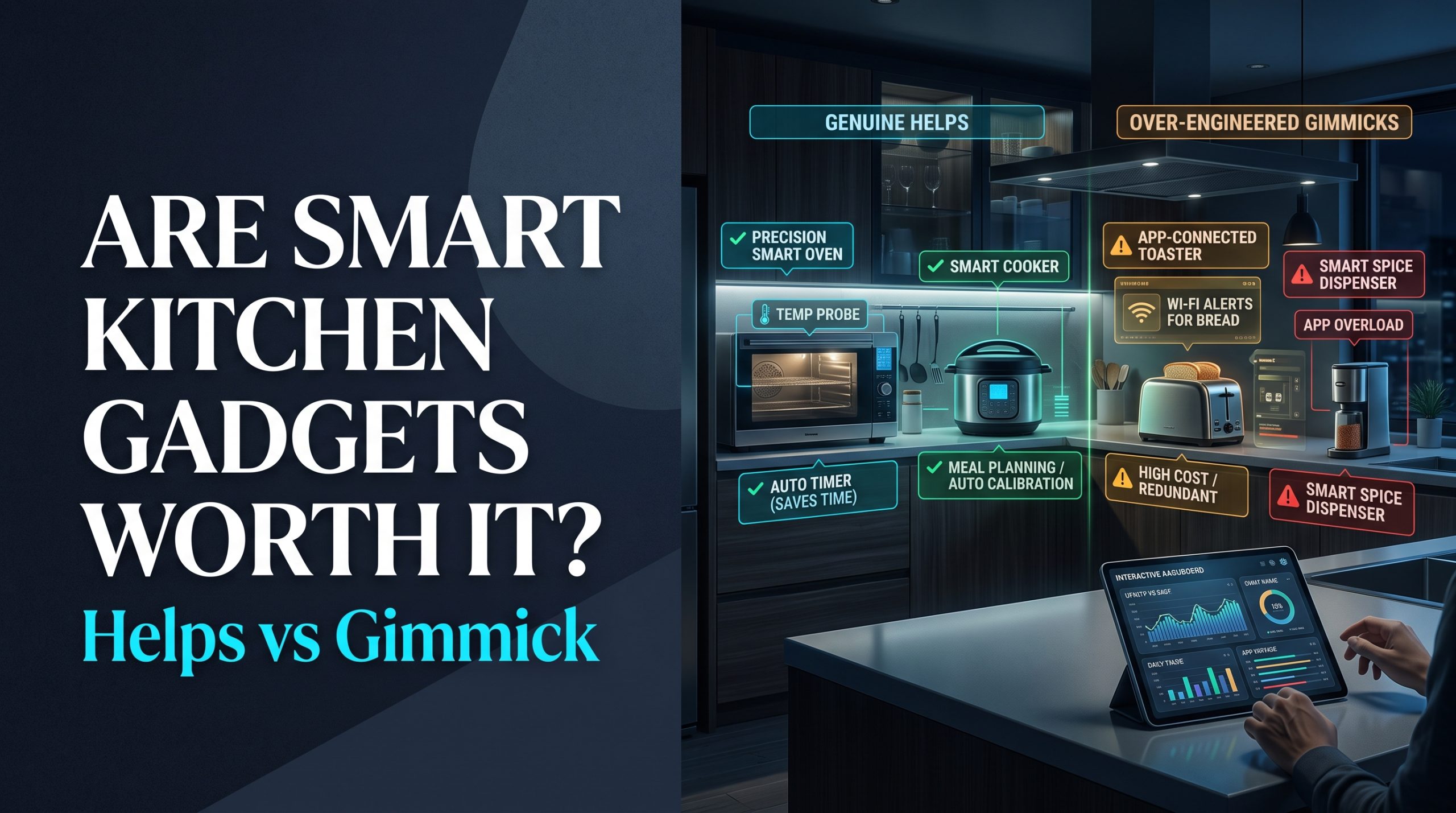
What a smart plug cannot do is make an unattended heat source safe. If an appliance should not be left alone, remote control does not change that. If you want to see which connected kitchen devices do add something, our overview of smart kitchen gadgets that change the way you cook covers the wider range.
Warning signs to stop using a smart plug
Unplug the smart plug and stop using it if you notice any of these:
- The plug, the outlet or the appliance cord feels warm or hot.
- There is a burning or plastic smell near the outlet.
- You see discoloration, scorching or melting on the plug or outlet.
- The circuit breaker trips when the appliance runs.
A plug that shows any of these signs should be replaced. If the outlet itself is warm, scorched, loose, or the breaker keeps tripping, stop there. That is a job for a licensed electrician. Do not open the outlet, change the wiring or replace the breaker yourself. The same applies to installing new kitchen outlets or adding a circuit.
Set it up securely
Every smart plug is a small device on your home network. Keep it on a secure network, use a strong account password, and turn on two-step login if the app offers it. Our guide to securing your Wi-Fi before adding smart devices covers the basics.
It is also worth checking what happens after a power cut. Some smart plugs return to their last state, others default to off. For a kitchen appliance, "off after a power cut" is usually the safer setting if the app lets you choose.
Simple routines that stay on the safe side
If you want your kitchen to feel a little smarter without adding risk, start with routines built around light and reminders rather than heat. A lamp that comes on at breakfast time, or a charger that switches off at night, gives you the convenience without the worry. Our look at easy morning routines you can automate shows how small those first steps can be.
FAQ
Can I put a coffee maker on a smart plug?
Often yes, if it is a simple model with a physical on switch, the plug's rating comfortably covers it, it has an automatic shutoff, and you are home while it runs. If your coffee maker has a built-in timer, that is usually the better choice.
Is it safe to plug a kettle into a smart plug?
It is not a good idea. Kettles are high-load heating appliances, and switching one on remotely creates the unattended heat risk fire safety authorities warn about. Kettles with an electronic start button would not respond to a smart plug anyway.
Why can't a smart plug turn on my appliance?
Many appliances use electronic buttons that reset to off when power is cut. A smart plug only restores power; it cannot press a button. Appliances with a physical switch left in the on position are the ones that start when the plug turns on.
How much load can a kitchen smart plug handle?
It depends on the model. Check the rating on the plug or the maker's specifications page, and compare it with the appliance label. TP-Link recommends keeping continuous loads at 80% or less of the plug's maximum rating.
Can I use a power strip with a smart plug in the kitchen?
It is best avoided. TP-Link says power strips are not recommended on its smart plugs because they can push the total load or surge current past the plug's design limits.

I’m John Smith, the founder of Homegadgetguru.com. I use my IT background to extensively test home automation setups in my own house, giving you the hands-on, practical advice you need to build a smarter, more connected home.