
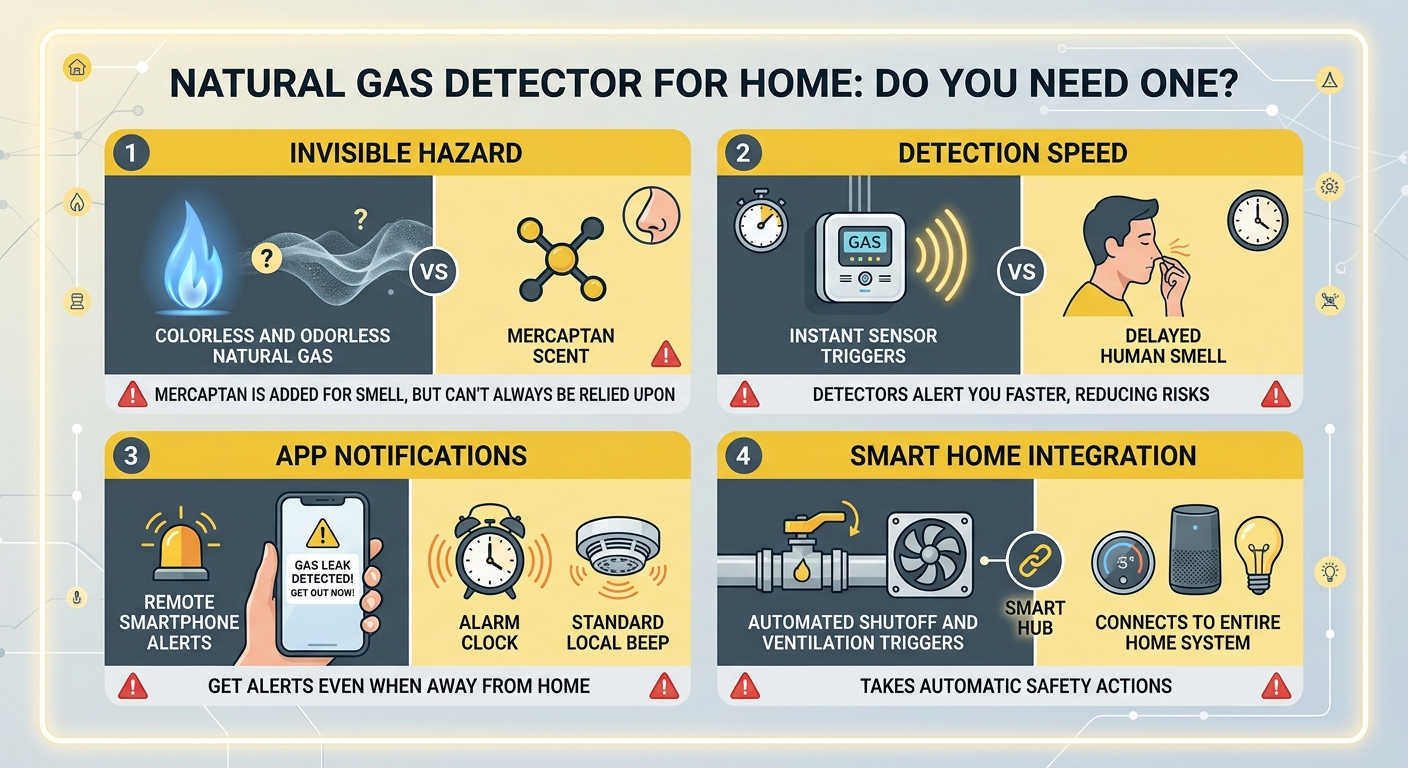
Short answer: if your home has a gas stove, gas furnace, gas water heater, or gas dryer, a natural gas detector for home use is a reasonable, low-cost addition to your safety layer, not a mandatory one. It is a separate device from a smoke alarm and a carbon monoxide (CO) alarm, built to sense methane in the air before the smell alone would warn you, which matters most while everyone is asleep. It does not replace either of those alarms, and it is not a substitute for calling your gas utility the moment you smell gas.
What a natural gas detector actually does (and doesn't)
Natural gas has almost no smell of its own. Utilities add a chemical called mercaptan specifically so a leak has a distinctive rotten-egg odor, but that odorant can fade over distance, get masked by cooking smells, or simply go unnoticed by someone asleep or with a reduced sense of smell. A natural gas detector solves that specific gap: it uses a sensor tuned to methane and sounds an alarm once the concentration in the air crosses a set threshold, independent of whether a person in the house can smell anything.
That is a different job from a smoke alarm, which reacts to combustion particles, and a different job from a CO detector, which reacts to carbon monoxide, a byproduct of incomplete combustion in appliances like furnaces and water heaters. A house can have a smoke alarm and a CO alarm and still have no coverage at all for an unlit gas leak, because none of those sensors are built to detect methane. If your home only has smoke and CO alarms, that is worth knowing plainly rather than assuming one device covers all three risks.
Do you actually need one?
The honest answer depends on what is already running gas in your home, not on how the product is marketed. This is the decision that matters more than any specific brand or model:
| Your situation | Where a gas detector fits |
|---|---|
| Gas stove, furnace, water heater, or dryer anywhere in the home | Reasonable addition, especially near the appliance and in a sleeping area |
| All-electric home, no gas appliances or gas line into the house | Little practical use; there is no gas to leak |
| Older gas appliances or a home where you've smelled gas before, even faintly | Higher priority; pair with a professional inspection, not just a sensor |
| Renting an apartment with gas appliances | A plug-in or battery unit is a reasonable request to bring with you, since it needs no permanent install |
None of this is a claim that a detector prevents a leak or a fire. It is a monitoring layer that gives you a warning earlier than smell alone would, on nights and in rooms where you would not otherwise notice.
Where to place a natural gas detector for home safety
Placement is not a style choice; it follows how the gas itself moves. Natural gas is lighter than air, so it rises and collects near the ceiling rather than settling low the way propane does. NFPA 715, the fuel gas detection standard, sets out that natural gas alarms should sit within about 12 inches of the ceiling and roughly 3 to 10 feet horizontally from the gas appliance they're monitoring, in the same room as that appliance, according to NFPA's own explanation of the standard (read 2026-09-18). That means kitchens, utility rooms, and basements with a furnace or water heater are the priority rooms, with a sleeping-area unit added so an alarm at 3 a.m. actually wakes someone.
Always follow the specific manufacturer instructions that come with the unit you buy over general guidance like this, since sensor placement can vary slightly by model.
The types you can actually install yourself
Every household natural gas detector worth buying for a DIY install falls into one of two categories, and both plug in or run on battery, not into your gas line or your home's wiring:
- Plug-in or battery-powered standalone units. These sit in an outlet or on a shelf, similar in size to a smoke or CO alarm, and sound a local alarm when they detect methane. Some combination units add CO detection in the same housing.
- Smart, WiFi-connected units. These add an app notification on top of the local alarm, so you get a phone alert if you're not home when it triggers. Because these connect to your home network, it's worth securing your WiFi before adding any smart home device, including a gas sensor, so the alert channel itself isn't the weak point.
Both types are within a homeowner's or renter's ability to install: plug it in, mount it, or set it on a shelf at the right height. What is not a DIY project is anything beyond that. A detector that requires hardwiring into your home's electrical system, or any device marketed as connecting directly to a gas line for continuous monitoring, is work for a licensed electrician or your gas utility, not a weekend task. If you smell gas strongly enough to suspect an active leak, the correct response has nothing to do with any detector: leave the house, don't flip light switches or use anything that could spark, and call your gas utility or emergency services from outside.
What a natural gas detector can't do
This is the part most product pages skip. A detector only warns about gas already in the air; it does nothing to find or fix the source of a leak, which still requires a professional inspection of your gas lines and appliances. It has a limited sensor lifespan, typically a few years, after which sensitivity can drop even if the unit still powers on, so check the manufacturer's replacement guidance rather than assuming it works indefinitely. A battery-powered unit is only as reliable as its battery, and a plug-in unit does nothing during a power outage unless it has its own battery backup. None of this makes the device useless. It means a gas detector is one layer in a safety plan that still includes appliance maintenance, professional inspection when something seems off, and knowing your gas shutoff location, not a replacement for any of those.
It is also worth being direct about independence here: this guide has not tested any specific gas detector model, and it is not recommending one brand over another. What follows a purchase decision like this is a UL 1484 listing, the Underwriters Laboratories standard for residential gas detectors (read 2026-09-18), which confirms a unit has been tested for sensitivity and false-alarm resistance. That listing is the checkable fact worth looking for on the box, rather than marketing language about detection speed or range.
Fitting it into a broader home safety layer
A gas detector is one sensor in a household that likely already has, or is planning, several others. If you're building out coverage from nothing, this site's beginner's guide to smart home security covers the order most homeowners buy in, and a hazard sensor like this fits alongside door sensors and cameras rather than instead of them. Households with an older adult or anyone who might not notice an alarm quickly should also read what actually helps for aging parents' safety, since a loud, isolated alarm in a basement is not the same as a system that reliably gets someone's attention.
If you go with a WiFi-connected unit, it is also worth understanding what data that app collects and how alerts are handled before you rely on it. This site's guide to what smart home apps actually collect is a reasonable next read before you connect any sensor to an account and a phone number you're depending on for a safety alert.
FAQ
What does a natural gas detector actually detect? It detects methane, the main component of natural gas, using a sensor tuned to that gas specifically. It does not detect smoke or carbon monoxide; those require separate alarms.
Is a natural gas detector the same as a carbon monoxide detector? No. They monitor different gases from different sources. Some combination units include both sensors in one housing, but a standalone CO alarm does not sense a natural gas leak, and a standalone gas detector does not sense CO.
Where should I install a natural gas detector in my home? Near the ceiling, roughly 3 to 10 feet from a gas appliance, in the same room as that appliance, per NFPA 715 guidance, plus a unit in or near a sleeping area so an alarm can wake you.
Can I install a natural gas detector myself? A plug-in or battery-powered unit, yes. Anything that requires hardwiring into your electrical system or connects to a gas line is work for a licensed electrician or your gas utility, not a DIY task.
What should I do if my detector goes off or I smell gas? Leave the house immediately, avoid switches or anything that could create a spark, and call your gas utility or emergency services from outside. Don't wait to investigate the source yourself.

I’m John Smith, the founder of Homegadgetguru.com. I use my IT background to extensively test home automation setups in my own house, giving you the hands-on, practical advice you need to build a smarter, more connected home.