Short answer: a home air quality monitor is worth it if you will act on what it shows: switching on the range hood when cooking spikes the particle reading, opening a window when carbon dioxide climbs in a closed bedroom, or checking whether an air purifier is making any difference. It is not worth it as a health test or as a safety alarm. Lab testing shows these devices are good at noticing when something changes and much weaker at saying exactly how much is in the air, and they miss things that matter.
This guide is independent and brand-neutral. It does not rank models. It explains what the category can and cannot tell you, using guidance from the U.S. Environmental Protection Agency (EPA) and published lab testing, so you can decide whether one fits the question you actually have.
What a home air quality monitor actually measures
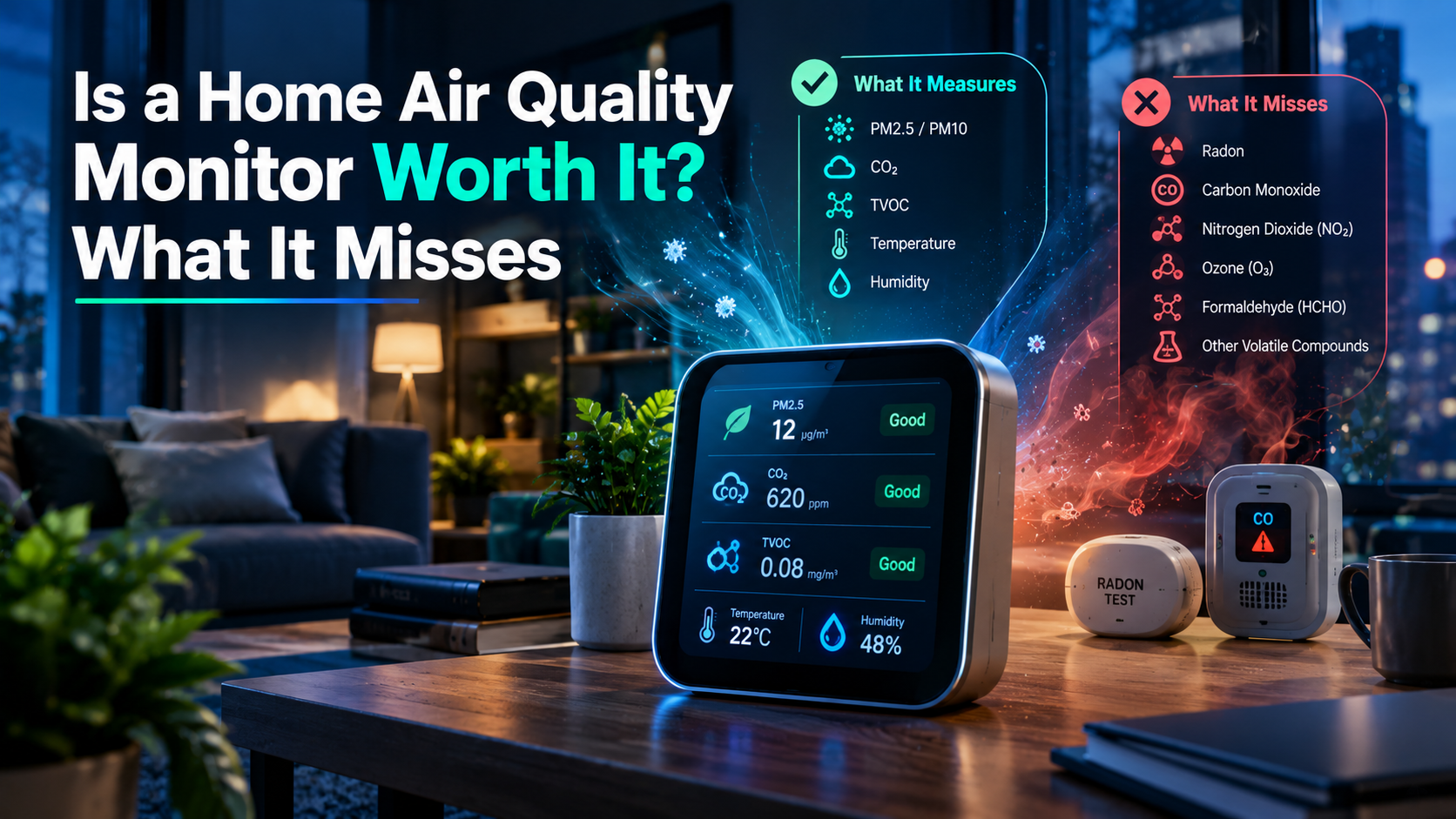
The EPA's page on low-cost air pollution monitors and indoor air quality (read 2026-09-24) lists what most of these devices sold in the U.S. are designed to detect: particulate matter, radon, carbon monoxide, carbon dioxide, formaldehyde, volatile organic compounds (VOCs), and environmental factors such as temperature and humidity. No single monitor necessarily covers all of that, and the EPA is plain about the limit: a monitor only detects the contaminants it was designed for.
Most home monitors combine a handful of these:
- Particles (PM2.5 and PM10): fine particles in the air, the reading that jumps when you cook or when smoke gets in.
- Carbon dioxide (CO2): a practical cue for how much fresh air a room is getting while people are in it.
- TVOC: one combined number for volatile organic compounds, a broad family of chemicals given off by many household products.
- Temperature and humidity: comfort and moisture.
- Radon, formaldehyde or carbon monoxide: only on models built with those specific sensors.
Before buying, read the spec sheet for how carbon dioxide is handled. Some monitors measure it with a dedicated optical sensor, usually listed as NDIR, while others show an "eCO2" or "CO2 equivalent" figure calculated from other readings. If ventilation is your reason for buying, that line matters more than the screen.
How far to trust each number
The most useful independent evidence on consumer monitors comes from chamber testing against reference instruments. A 2021 study published in Building and Environment, with Lawrence Berkeley National Laboratory among the research institutions, put eight multi-parameter consumer monitors through controlled tests (read 2026-09-24). Here is what it found, and what that means at home:
| Reading | What the 2021 chamber study found | Reasonable use at home |
|---|---|---|
| Particles (PM) | Under-reported reference measurements by up to 50% | Spotting when cooking or smoke raises particles, and whether ventilation brings them back down |
| Carbon dioxide | Acceptable responses within 15% | A ventilation cue for bedrooms, home offices and other closed rooms |
| TVOC | Diverging results with poor quantitative agreement | Only as a sign that something changed, never as a measurement |
| Temperature | Most within plus or minus 0.6 °C | Reliable for comfort tracking |
| Humidity | Within plus or minus 5% relative humidity | Reliable enough to notice a room that stays damp |
The same study found that most of the devices could detect source events and were strongly correlated with the reference data. That is the honest summary of the whole category: trust the change, not the number. A spike when you sear something on the stove is real. The exact figure on the screen may be well off, and for TVOC in particular, two devices in the same room can disagree.
It also helps to know what official backing exists, which is none. The EPA says it does not make recommendations or endorsements on specific low-cost monitors for indoor use, and that it does not generally evaluate them under indoor test conditions. It adds that there is limited information on the accuracy and precision of the monitors currently on the market.
What these monitors miss
This is the section that decides whether a monitor fits your worry, and it is the part most product pages leave out.
Carbon monoxide safety. The EPA states that, unlike alerts from carbon monoxide alarms or smoke detectors, alerts from low-cost air pollution monitors are not designed to warn of the potential for immediate danger to your health or life. It says CO alarms certified to UL Standard 2034 or IAS 6-96 should be present in every home. A monitor that shows a CO number does not replace one.
Radon, unless the device is built for it. Radon is measured only by monitors that carry a radon sensor. The EPA's own example is that if a radon monitor detects a level above EPA's action level of 4 pCi/L, you may wish to use a long-term test or consult a radon professional.
Ultrafine particles. Lawrence Berkeley National Laboratory's indoor environment group notes that none of the consumer monitors it evaluated detected sources that mostly released ultrafine particles.
Which chemical it is. A TVOC reading lumps many compounds into one number. It can tell you the air changed after you cleaned or painted, not what was released or whether it matters.
Mold. Mold is not on the EPA's list of what these monitors typically detect. A monitor can show that a room stays damp, which is a reason to look for a moisture source, not a mold verdict.
A health verdict. The EPA notes that pollutant concentrations do not necessarily translate directly into health outcomes, and that for most pollutants there are no widely accepted indoor health-based standards or thresholds. So when an app turns a reading red, that color reflects the maker's chosen scale, not an agreed indoor health limit.
When a home air quality monitor is worth it, and when it is not
The deciding question is simple: will a reading change what you do? If yes, a monitor pays for itself in information. If no, it becomes a worry on a screen.
It tends to be worth it when:
- You cook often and have a range hood or a window you can open, and you want to know when to use them.
- You want to know whether a bedroom or home office gets enough fresh air with the door closed.
- Outdoor smoke or pollution days leave you wondering whether it is getting inside.
- You want to check whether an air purifier, a new filter or a ventilation change is making a measurable difference.
- You have just painted or finished a project and want to see when the air settles back to normal.
It is usually not worth it when:
- You want an explanation for symptoms. The EPA suggests talking with a healthcare provider about health concerns rather than relying on monitor readings alone. If someone at home has symptoms or a breathing condition, a doctor is the right first stop; a monitor can add context, not a diagnosis.
- You need a safety alarm. Carbon monoxide calls for a certified CO alarm, and smoke calls for a smoke alarm.
- Your worry is radon or mold specifically. A radon test or dedicated radon monitor answers the first; finding and fixing a moisture source, with professional help where needed, answers the second.
- You would not change anything based on what it shows.
On cost, think in tiers rather than price tags. Budget monitors typically cover particles, temperature and humidity. Mid-range models tend to add a dedicated CO2 sensor, TVOC and an app with history and alerts. Premium models add more sensor types, sometimes radon, and longer data history. Buy the tier that measures the question you have, not the one with the most numbers.
Turning readings into cleaner air
The EPA frames what to do with readings as three strategies: source control, ventilation, and supplemental filtration and air cleaning. Its own examples are practical ones. If your particle reading rises while cooking, you may want to increase exhaust ventilation by turning on a range hood or opening a window or door. And in the EPA's classroom example, rising carbon dioxide is a cue to open a window to increase ventilation.
The most useful habit is the one the EPA describes directly: compare readings before, during and after an activity like cooking. Run the hood one evening and not the next, and watch how fast the particle line falls. Move the purifier and see whether the bedroom reading changes. That kind of side-by-side check plays to what these devices do well, which is showing change.
Setting one up so the readings mean something
The EPA notes that accuracy can be affected by where the monitor sits, how long it has been in use, how its data is processed, temperature, humidity, and the presence of multiple contaminants. A few practical rules follow from that:
- Put it in the room you care about, at roughly the height where people sit or sleep.
- Keep it away from single sources, such as right beside the stove, a window, a vent or a humidifier, unless that source is exactly what you want to watch.
- Check the manual for any warm-up or calibration period before you trust the first readings.
Most monitors with an app connect over Wi-Fi, so treat them like any other connected device and secure your Wi-Fi before adding smart home devices. It is also worth reading what data smart home apps collect before you sign up, because a carbon dioxide history rises and falls with people in a room, which means it quietly records when rooms are occupied.
If you are setting up safety devices in an older relative's home, keep the same boundary in mind: a monitor is a comfort and ventilation tool, and the alarms come first. Our guide to smart home safety for elderly parents covers the wider setup.
Frequently Asked Questions
Can a home air quality monitor detect carbon monoxide?
Some models include a CO sensor, but the EPA says alerts from low-cost monitors are not designed to warn of immediate danger to health or life. A CO alarm certified to UL 2034 or IAS 6-96 is the device for that job.
Are cheap air quality monitors accurate?
A 2021 chamber study of eight consumer monitors found carbon dioxide within 15%, particles under-reported by up to 50%, and poor agreement on TVOC. Most still tracked changes well, so they are better at trends than exact numbers.
Does an air quality monitor detect mold or radon?
Not mold. Radon only if the device has a radon sensor, and the EPA suggests a long-term test or a radon professional if a radon monitor shows levels above its 4 pCi/L action level.
Where should I put an air quality monitor?
In the room you care about, at breathing height, and away from the stove, windows, vents and humidifiers so it reads the room rather than one source. The EPA notes that placement affects accuracy.
Does the EPA recommend a specific air quality monitor?
No. The EPA says it does not make recommendations or endorsements on specific low-cost monitors for indoor use, and it does not generally evaluate them under indoor test conditions.

I’m John Smith, the founder of Homegadgetguru.com. I use my IT background to extensively test home automation setups in my own house, giving you the hands-on, practical advice you need to build a smarter, more connected home.