
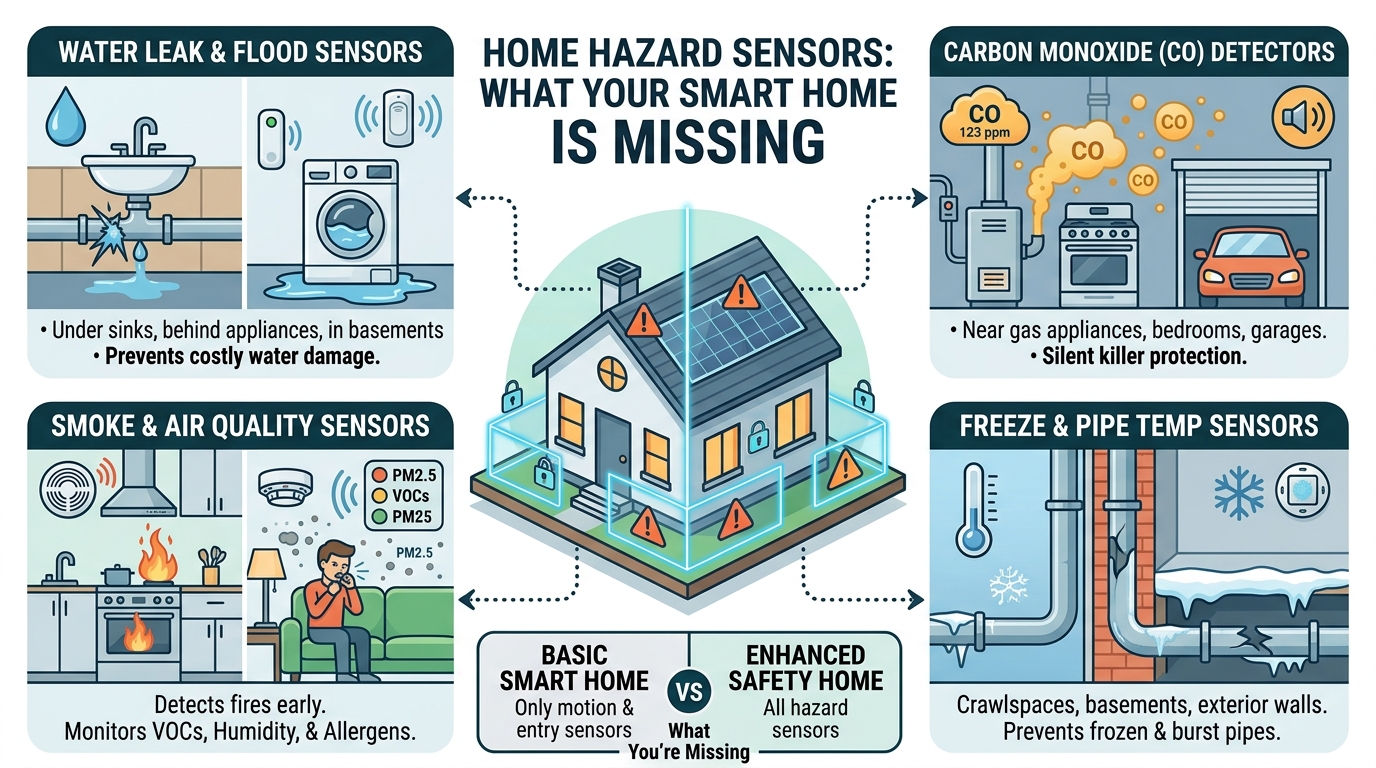
Home hazard sensors are the devices that watch for smoke, carbon monoxide, water leaks, freezing pipes, and poor indoor air quality: the kind of danger that has nothing to do with someone at the door. Most smart home starter kits lead with a video doorbell, an indoor camera, and a smart lock, so hazard sensors end up treated as an accessory instead of a foundation. That gap matters, because a camera that records a break-in cannot warn a household about a gas leak or a burst supply line. This guide covers which hazard sensors actually earn a place in a smart home, where DIY installation has to stop, and the privacy trade-off that comes with any sensor that reports to a phone app.

What Counts as a Home Hazard Sensor
A hazard sensor monitors a physical condition in the home, not a person. That covers smoke and fire, carbon monoxide, water leaks and flooding, freezing pipes, and, on some devices, indoor air quality readings like elevated particulates. It does not cover motion in a hallway or a door left ajar. Motion sensors, door and window contacts, and cameras are built to notice people moving through a space; they are not designed to detect a slow leak under a water heater or a smoldering electrical fault behind a wall. Treating a security-focused starter kit as complete coverage for the home is the mistake this category exists to fix, because the two sensor families are answering entirely different questions. A household can have a fully armed security system, motion sensors in every room, and cameras covering every entry point, and still have zero warning of a gas leak in the kitchen or a slow leak behind the refrigerator, because none of those devices are built to notice it.
Why This Layer Gets Skipped
Budget and attention both tend to go to the visible layer first: a camera on the porch, a smart lock on the front door, a base station in the hallway. Those devices are easy to demonstrate and easy to market, since a visitor can see the doorbell and hear the lock click. A water leak sensor tucked behind a washing machine, or a carbon monoxide alarm near a bedroom, does its job silently for months or years and only matters on the one day something goes wrong. That asymmetry is exactly why hazard sensors are the layer most smart homes add last, if at all, even though fire, gas, and water damage are ordinary household risks that have nothing to do with whether the neighborhood feels safe. The result is a common but uneven setup: strong coverage against intruders, and no coverage at all against the hazards that are statistically far more likely to affect a given home in a given year.
The Core Hazard Sensor Types Worth Adding
Carbon monoxide has no smell, color, or taste, so a working alarm is the only practical way a household finds out it is present. The Consumer Product Safety Commission recommends a CO alarm on every level of a home and outside each sleeping area, tested monthly with the battery replaced at least once a year, and notes that a CO alarm should never be treated as a substitute for a smoke alarm or vice versa (CPSC, read 2026-09-18). That guidance holds whether the alarm is a basic battery unit or a connected model that also sends a phone alert; the placement rule does not change just because the device is smart.
Beyond combined smoke and CO alarms, three other sensor types round out the category for most homes:
- Water leak and flood sensors, placed near water heaters, washing machines, dishwashers, and under sinks, which flag moisture before it spreads to flooring or drywall.
- Freeze sensors, useful in homes with a vacation property, a crawl space, or a section of plumbing that runs along an exterior wall, since a burst frozen pipe is a water event that starts as a temperature event.
- Indoor air quality sensors, which track particulates or elevated VOC levels and are a lower-priority add for most households compared with smoke, CO, and water coverage.
None of these sensors replace each other, and a household does not need every category on day one. Smoke and CO coverage comes first because it is life-safety; water and freeze sensors come next because they protect the structure and belongings; air quality is worth adding once the first two categories are in place. The point of listing them is to show what "hazard coverage" actually includes, not to rank specific products against each other.
Where DIY Installation Stops
The same decision point that applies to cameras and alarms applies here: our guide to where DIY security work should stop covers the line between a battery swap and a job for a licensed trade, and hardwired hazard alarms sit on the professional side of that line. A battery-powered or plug-in sensor is a reasonable DIY install for most homeowners: mounting it on a wall or ceiling, pairing it with an app, and testing it monthly does not require touching household wiring. A hardwired smoke or CO unit tied into the home's electrical circuit, or an interconnected system where one alarm triggers all the others through household wiring, is different: that work involves the home's electrical supply, and it stops at a licensed electrician. If a hardwired detector needs replacing or a new one needs adding to an interconnected loop, that is the point to call a professional rather than open the junction box.
The Privacy Trade-off Nobody Mentions
A hazard sensor that reports to an app is still a device connected to the home network, and it collects data to do its job: when it was triggered, how often it checks in, sometimes ambient readings from the room it sits in. The Federal Trade Commission's guidance for connected device makers urges companies to be transparent about what data they collect, why, and how they secure it (FTC, read 2026-09-18), which is a reasonable standard to hold any hazard sensor to before it joins the network. Before adding one, it is worth reading the maker's own privacy page the same way our smart home privacy policy breakdown recommends for cameras and locks, since a leak sensor sitting on the home network still has access to it. A Wi-Fi hazard sensor is also only as safe as the network it joins, which is the reason to secure the home network before adding smart devices rather than after. None of this means skipping the category; it means treating a hazard sensor's data connection with the same scrutiny given to a camera, rather than assuming a "safety" device gets a pass on privacy questions.
How Hazard Sensors Fit Into the Rest of the Smart Home
Most hazard sensors connect over the home Wi-Fi network or through a separate hub protocol, and report into the same app that already runs cameras, locks, or lighting. That connection is useful: a triggered smoke alarm can flash smart lights or push a notification to every household phone at once, which matters if the alarm sounds while someone is in a part of the house where it is hard to hear. It also means a hazard sensor is one more device on the network's attack surface, not a separate, isolated safety appliance, which is exactly why the network security step above comes before adding one rather than after.
Fitting Hazard Sensors Into a Layered Plan
Hazard sensors earn their keep most clearly when nobody is home to notice a slow leak, a failing pilot light, or a freezing pipe before it bursts. A pre-trip home security checklist that only walks through locks and cameras misses this category entirely. Before leaving for more than a couple of days, it is worth adding a check of hazard sensor batteries, app notifications, and whether anyone, a neighbor, a family member, or a monitoring service, will actually see an alert while the household is away.
What To Do When a Hazard Sensor Goes Off
A phone notification is not the emergency response. If a smoke or CO alarm is actually sounding, get everyone out into fresh air right away and call 911 or the local fire department before troubleshooting the device or checking the app; the alarm exists to move people out of the building, not to start a support ticket. For a water leak alert, shut off the water at the main or the fixture's shut-off valve, and call a licensed plumber for anything beyond a simple supply-line fitting. A hazard sensor is a warning system, not a first responder, and a genuine emergency always goes to 911 or local authorities first, whatever the app says.
FAQ
Do I need hazard sensors if I already have a security system? Yes, if that system is built around cameras, a video doorbell, and door or window sensors. Those devices detect people, not smoke, gas, or water. A separate hazard sensor layer covers a different set of risks entirely.
Can a smart hazard sensor replace a hardwired smoke alarm? No. A battery or plug-in smart sensor is a useful addition, but a home's required hardwired or interconnected smoke and CO alarms stay in place; replacing or rewiring them is work for a licensed electrician, not a DIY swap.
How many carbon monoxide alarms does a home need? The Consumer Product Safety Commission recommends one on every level of the home and outside each sleeping area, tested monthly with the battery changed at least once a year.
Are Wi-Fi hazard sensors a privacy risk? Any connected sensor collects some data to function and is only as secure as the network it joins. Reading the maker's privacy page and securing the home Wi-Fi network first are the two practical steps before adding one.
What should I do if a water leak sensor alerts while I'm not home? Call someone who can physically shut off the water at the main valve as soon as possible, and follow up with a licensed plumber if the leak is anything more than a loose fitting.

I’m John Smith, the founder of Homegadgetguru.com. I use my IT background to extensively test home automation setups in my own house, giving you the hands-on, practical advice you need to build a smarter, more connected home.