
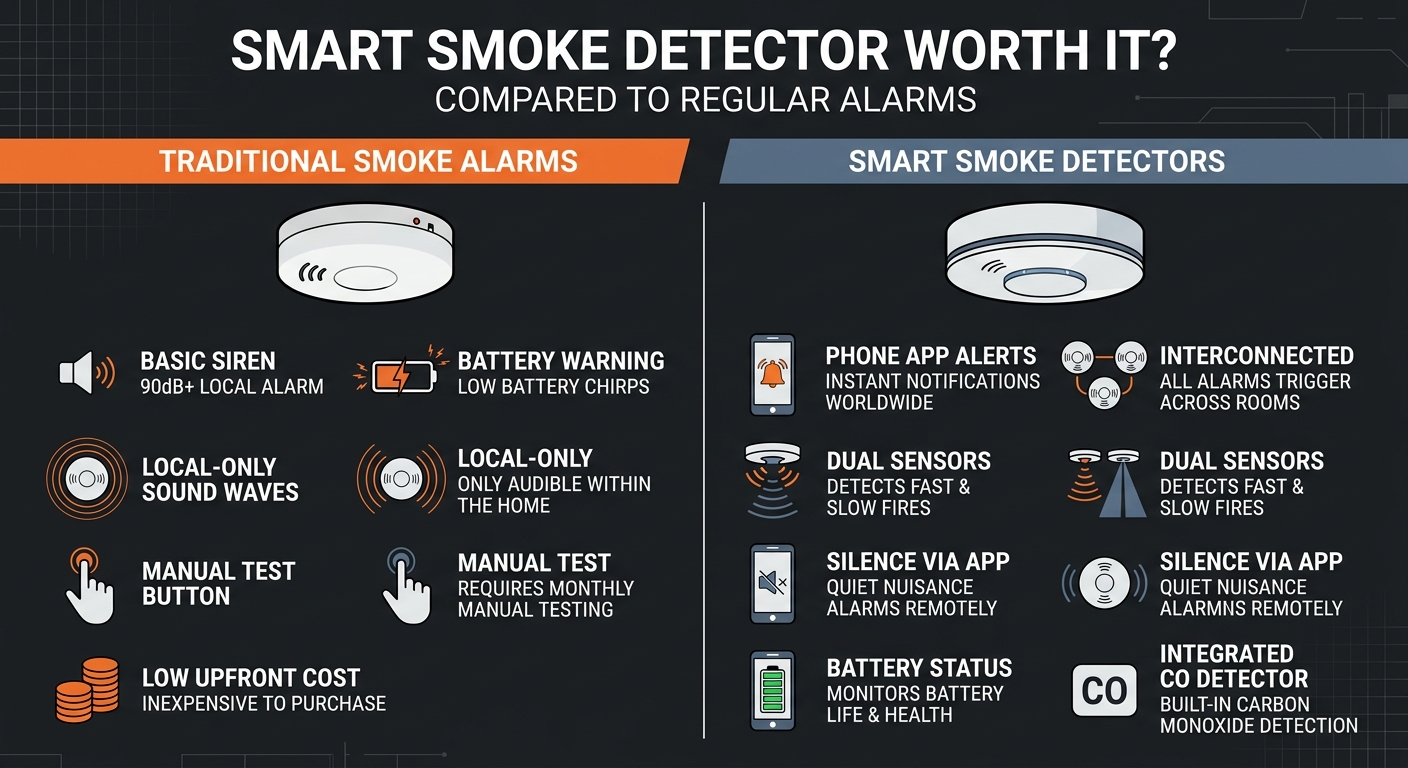
A smart smoke detector is worth it mainly for one reason: it can reach you when you are not close enough to hear the siren. It does not sense fire any better than a good ordinary alarm; the sensing technology inside both types is largely the same. What a smart unit adds is a phone alert, interconnection across the home, and sometimes which room triggered first. If your household is often empty, someone sleeps behind a closed door, or you travel, that reach has real value. If you already have a hardwired, interconnected alarm system and someone is almost always home to hear it, a smart upgrade solves a problem you may not have.

Quick take, before the detail:
- A smart smoke detector is worth it if: the home is often empty, someone travels often, hearing or mobility limits make a local siren unreliable, or a phone alert while away matters to you.
- A standard interconnected alarm is enough if: someone is reliably home to hear it, the home already has hardwired interconnected alarms, and remote alerting isn't a priority.
What "Smart" Actually Adds, and What It Doesn't
A smart smoke detector's core job, detecting smoke or heat, works the same way a standard photoelectric or ionization alarm does. Independent guidance from fire safety authorities does not treat "smart" as a separate detection category; the National Fire Protection Association frames the buying decision around sensor type (photoelectric versus ionization) and interconnection, not around app connectivity, in its consumer guidance on choosing a smoke alarm (NFPA, read 2026-09-18). So the upgrade is not about catching a fire sooner at the sensor level. What it changes is what happens after the sensor triggers: a push notification to your phone, a log of which unit went off first, an app-based test or hush, and on some systems a self-check that flags a failing sensor before it goes silent. Some models also reduce nuisance alerts tied to cooking steam, though how well that works varies by model and this article does not endorse or rank specific products.
Who a Smart Smoke Detector Is Worth It For
The upgrade earns its keep in specific situations, not as a blanket recommendation. A household that is frequently empty during the day benefits, because a local siren protects nobody if no one is there to hear it, but a phone alert still reaches you. The same is true for anyone who travels regularly and wants to know about a problem before returning home. Homes with a family member who has limited hearing, or an older adult living alone, are another case worth planning around; our guide to smart home security for elderly parents covers the broader monitoring picture that a smart smoke detector fits into. A larger home where a ceiling siren in one wing may not wake someone sleeping in another also benefits from a system that pushes the same alert to every phone in the house at once.
When a Regular Interconnected Alarm Is Enough
If your home already has hardwired, interconnected smoke alarms and someone is reliably home and awake to hear them, a smart upgrade is optional rather than necessary. A properly interconnected system already solves the "one alarm, whole house" problem that smart alarms are often sold on, because every hardwired unit sounds together when one detects smoke. The gap a smart detector closes is remote awareness, not in-home coverage. If your household already pays for a monitored security system that includes fire monitoring through a control panel, compare what that monitoring already covers before adding a separate smart smoke detector subscription; our comparison of self-monitored versus professionally monitored security walks through that overlap. Budget also matters here: standard alarms sit in the entry-level price tier, while smart units, and any companion app subscription, sit in a higher tier, so the decision is genuinely a tradeoff and not a strict upgrade.
Installation: Where DIY Stops
Battery-powered and plug-in smart smoke detectors are a reasonable DIY project: mount the bracket, insert the battery, pair the app, done. Hardwired smoke alarms are a different job. They tie into the home's electrical circuit and, in many homes, an interconnect wire linking every alarm in the house, and that work should go to a licensed electrician rather than a homeowner. If you are replacing a hardwired unit with a hardwired smart model, or adding interconnection to a home that does not already have it, that is electrical work behind the wall plate, not a battery swap, and it stops at the point where you would need to touch house wiring. Choose a battery or plug-in smart model if you want a DIY installation, and treat any hardwired conversion as a licensed electrician's job from the start.
How Smart Alarms Actually Interconnect
Interconnection means that when one alarm senses smoke, every alarm in the home sounds together, not just the unit nearest the fire. Traditional hardwired systems do this over a dedicated interconnect wire run between units during construction. Smart alarms interconnect a different way: many use the home's Wi-Fi network, a proprietary radio link, or increasingly the Matter smart home standard running over the Thread wireless protocol, which lets alarms from different manufacturers join the same mesh and pass an alert from unit to unit even if one loses its own Wi-Fi connection. That mesh approach is genuinely useful in an older home with no interconnect wire between rooms, because it recreates whole-house alerting without opening a wall. It is not, however, a substitute for power and battery backup: a wireless mesh alarm still needs power to run, and sending a phone alert still depends on an internet connection at the router, which is worth remembering before treating "smart" and "interconnected" as the same guarantee.
Battery Backup and Power Outages
A smoke alarm's most basic job, sounding a local siren, should not depend on the internet or even household power staying on, which is why every smoke alarm, smart or standard, needs to keep working on battery alone during an outage. Hardwired alarms carry a battery backup for exactly this reason, and battery-only smart alarms already run this way by default. What changes during an outage is the smart layer on top: if your router and modem lose power, a Wi-Fi-connected smart detector can usually still sound its local alarm, but it will not push a phone alert until the network is back, because the alert has to travel through your home internet connection to reach the app's cloud service. A hub-based system with its own cellular or battery-backed hub may keep sending alerts through an outage; a purely Wi-Fi-based one will not. If remote alerting during a power outage matters to your household, ask that question before buying rather than after the first outage answers it for you.
Before You Buy: Connectivity and Privacy Questions
A smart smoke detector only sends phone alerts if it stays connected to your home network, so a stable Wi-Fi setup matters more here than it does for a device with no safety function; see our guide to securing Wi-Fi before adding smart home devices if your network hasn't been set up with that in mind. It's also worth asking, before buying, what data the detector and its app collect and store, since a device that reports to a cloud service is handling information about when your home is occupied. Some smart smoke detectors also require a paid subscription for full remote alerting or professional monitoring, which is worth weighing against a smart home security setup with no monthly fee if recurring cost is a concern. None of this makes a smart detector unsafe to use; it just means the buying decision includes a few questions a standard alarm never asks.
The Rules That Don't Change Either Way
Regardless of which type you choose, the placement and maintenance basics stay the same. The Consumer Product Safety Commission recommends a smoke alarm on every level of the home, outside each sleeping area, and inside each bedroom, tested monthly and replaced once it is more than ten years old, because the sensor inside degrades over time even if it still passes a test (CPSC, read 2026-09-18). Keep alarms at least ten feet from cooking appliances to cut down on false alarms from steam and smoke. If you ever find aluminum wiring, exposed wiring, or damage near an alarm's electrical connection, stop and call a licensed electrician; that is not a homeowner repair. No smoke alarm, smart or standard, replaces a plan: know two ways out of every room and a meeting point outside, because the alarm's only job is to give you time to use that plan.
FAQ
Does a smart smoke detector detect fire faster than a regular one? No. The smoke and heat sensing is largely the same technology in both types. The difference is what happens after detection: a smart unit can push an alert to your phone, while a standard alarm only sounds locally.
Do smart smoke detectors need Wi-Fi to work at all? They still sound their local siren without a network connection, since that function runs on battery or house power independently. Wi-Fi (or a hub connection) is only required for phone alerts, remote hush, and app-based testing.
Can I install a smart smoke detector myself? Battery-powered and plug-in models, yes. Hardwired models, or adding interconnection where none exists, involve house wiring and should go to a licensed electrician rather than a DIY install.
Do smart smoke detectors replace a monitored fire alarm system? Not necessarily. A monitored system typically alerts a monitoring center that can call the fire department; many consumer smart smoke detectors only alert your phone. Check what each option actually does before assuming one replaces the other.
How often do I need to replace a smart smoke detector? The same ten-year rule applies as for standard alarms, per CPSC guidance, unless the manufacturer's instructions state otherwise. Check the manufacture date on the back of the unit, not the date you installed it.

I’m John Smith, the founder of Homegadgetguru.com. I use my IT background to extensively test home automation setups in my own house, giving you the hands-on, practical advice you need to build a smarter, more connected home.