
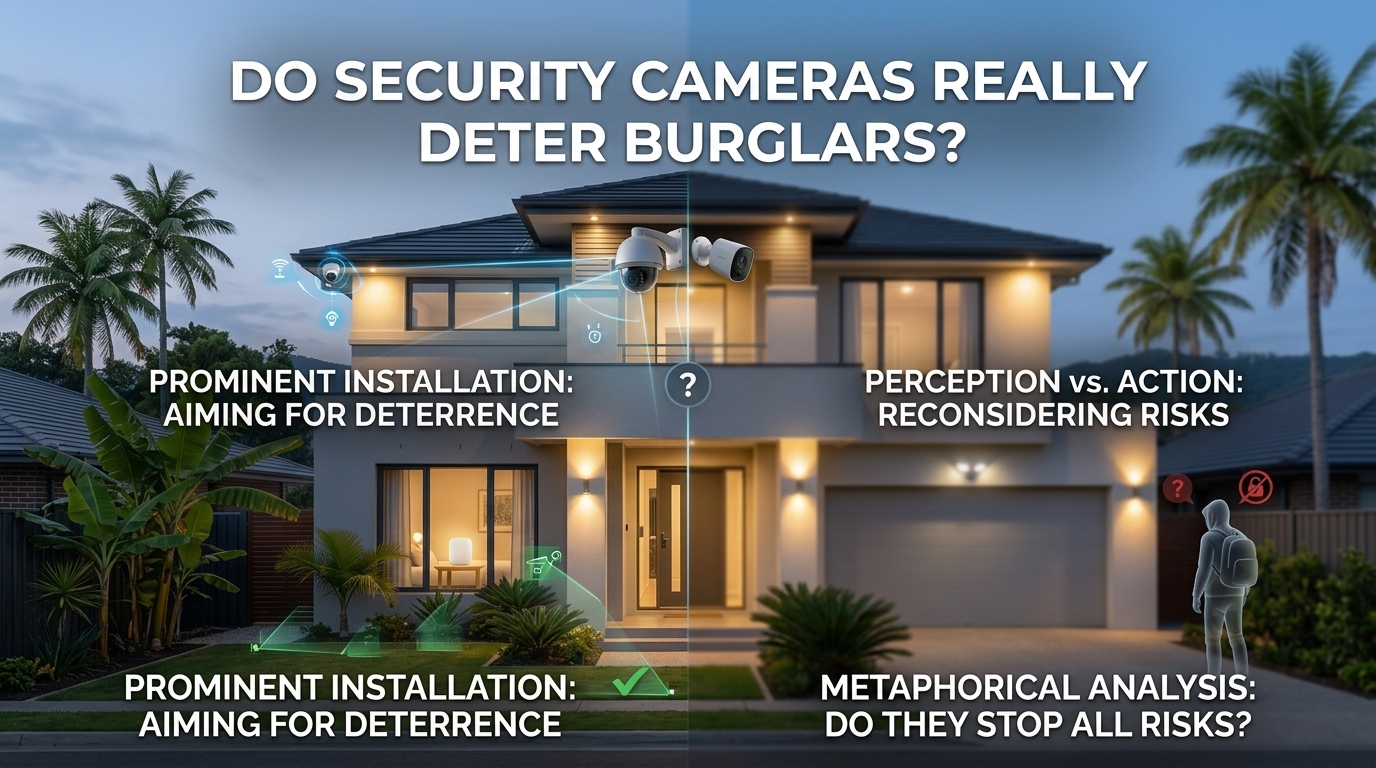
Visible security cameras do deter a meaningful share of burglars, but the effect depends heavily on whether the camera looks actively monitored, not just present. Survey research from the security industry, most often cited to the Alarm Industry Research and Educational Foundation, and separate research referenced by the University of North Carolina at Charlotte both find that a majority of surveyed or convicted burglars say they avoid homes with visible cameras or alarm signage when they can. The deterrent effect is strongest against opportunistic, casual burglars sizing up several houses on a street, and weakest against someone who has already specifically targeted your home. A camera nobody ever watches is a weaker deterrent than one that visibly could be.
That is the honest, sourced version of the claim you have probably seen repeated as a flat statistic. The rest of this guide names where these numbers actually come from, why the "monitored vs passive" distinction matters more than most guides mention, and what deterrence realistically cannot do for you.
What the research actually says (named sources, not vague "studies show")
Two sources get cited constantly on this topic, and it is worth knowing what each one actually is.
The first is survey research most often attributed to the Alarm Industry Research and Educational Foundation, which surveyed convicted burglars about what influenced their target selection. The commonly repeated figure is that a large majority of respondents said they check for a visible camera or alarm system before choosing a target, and would move on to an easier house if they saw one.
The second is a study referenced by the University of North Carolina at Charlotte, which surveyed convicted burglars and found that roughly six in ten said they would avoid a property with a visible security system, including cameras.
Both are real, both are frequently cited by security companies and independent outlets alike, and both should be read as self-reported survey data, not a controlled experiment. Asking a convicted burglar what influenced their decision after the fact is genuinely useful information, criminologists use it deliberately, but it is directional evidence about typical behavior, not a precise probability that applies to any individual burglar or any individual home.
Why the effect is strongest against opportunistic burglars, weakest against targeted ones
The research is consistent on one distinction that matters more than the headline statistic: deterrence works best against opportunistic crime. A person casing a street for an easy target, unlocked door, no visible security, will typically move on when a camera is obvious. That is the majority of residential burglary.
Deterrence is far less reliable against someone who has already decided your home specifically is the target, for whatever reason. A camera might still help after the fact, by capturing usable footage, but it is not realistic to expect a determined, targeted intrusion to be stopped by a doorbell camera the way a casual break-in attempt often is.
Monitored vs passive: the distinction most guides skip
Here is the detail that gets lost when a guide just repeats "cameras deter crime." Research on actively monitored systems, ones with a real-time human or service watching feeds or responding to alarms, shows a measurable reduction in crime. Research on passive, record-only systems, ones that just save footage for later with nobody watching in real time, shows a far smaller effect, and some studies find no statistically significant deterrence from passive recording alone.
That distinction is something a reader can actually act on. A camera that is visibly connected to an app, has a light or indicator showing it is active, or is paired with a sign referencing monitoring, is doing the kind of visible, "someone might be watching this right now" work that the research says actually deters. A camera hidden and never checked is doing almost none of that work, even though it might still capture useful footage later.
If you are weighing whether that "someone might be watching" layer should be a person on your phone or a paid monitoring service, that decision is its own topic, covered in our self-monitoring vs professional monitoring guide.
Signage and visibility: does it matter if the camera is fake?
The same research that finds burglars check for cameras also finds they are checking for visible signals, not verifying that a device is real and functional. A dummy camera or a security sign can produce some of the same opportunistic-deterrence effect, because most casual burglars are not testing whether the device works, they are avoiding the appearance of risk. That said, a fake camera provides zero benefit if a burglary does happen: no footage, no alert, nothing. Visible signage and real cameras are not equivalent bets, they just happen to share one narrow benefit against opportunistic crime.
What deterrence cannot do
Cameras, monitored or not, are a deterrent and an evidence tool. They are not a barrier. A camera does not stop a door from being kicked in, does not lock a window, and does not physically prevent entry once someone has decided to try. Deterrence reduces the odds you get targeted in the first place; it does not replace the physical security layer, locks, sensors, lighting, that matters once someone has already decided to attempt entry regardless of the camera. If you are building that physical layer from scratch, our guide to a smart home security system with no monthly fee walks through the full build order cameras fit into.
It is also worth being honest that no camera, monitored or not, changes the outcome for a crime driven by impulse, substance use, or desperation rather than a calculated risk decision. The research on deterrence describes typical, rational-actor behavior. It does not describe every possible burglar.
FAQ
Do security cameras really stop burglars? They reduce the odds of being targeted, especially by opportunistic burglars checking several homes for an easy one, according to self-reported surveys of convicted burglars. They do not physically stop an intrusion once someone has already decided to attempt one.
Does it matter if the camera is real or fake? For opportunistic deterrence, a visible sign or dummy camera can produce some of the same effect, since most casual burglars are reacting to the appearance of risk rather than testing the device. A fake camera provides no benefit at all if an intrusion does happen, since it captures nothing.
Is a monitored camera more effective than one that just records? Yes, according to the research. Actively monitored systems show a measurable reduction in crime, while passive, record-only systems show a much weaker or, in some studies, no statistically significant deterrent effect on their own.
Where should cameras go to maximize deterrence? Visible placement at entry points, front door, back door, driveway, tends to do the most deterrent work, since that is what an opportunistic burglar is scanning for during a quick pass of a property. Our guide to how many security cameras you actually need walks through counting those spots for your own home.
Do cameras help even if they do not deter a specific burglar? Yes. Even when deterrence fails, footage supports a police report and insurance claim after the fact. Deterrence and evidence are two separate benefits of the same device, and a camera can still be worth having even in the cases where nothing stopped the attempt.

I’m John Smith, the founder of Homegadgetguru.com. I use my IT background to extensively test home automation setups in my own house, giving you the hands-on, practical advice you need to build a smarter, more connected home.