
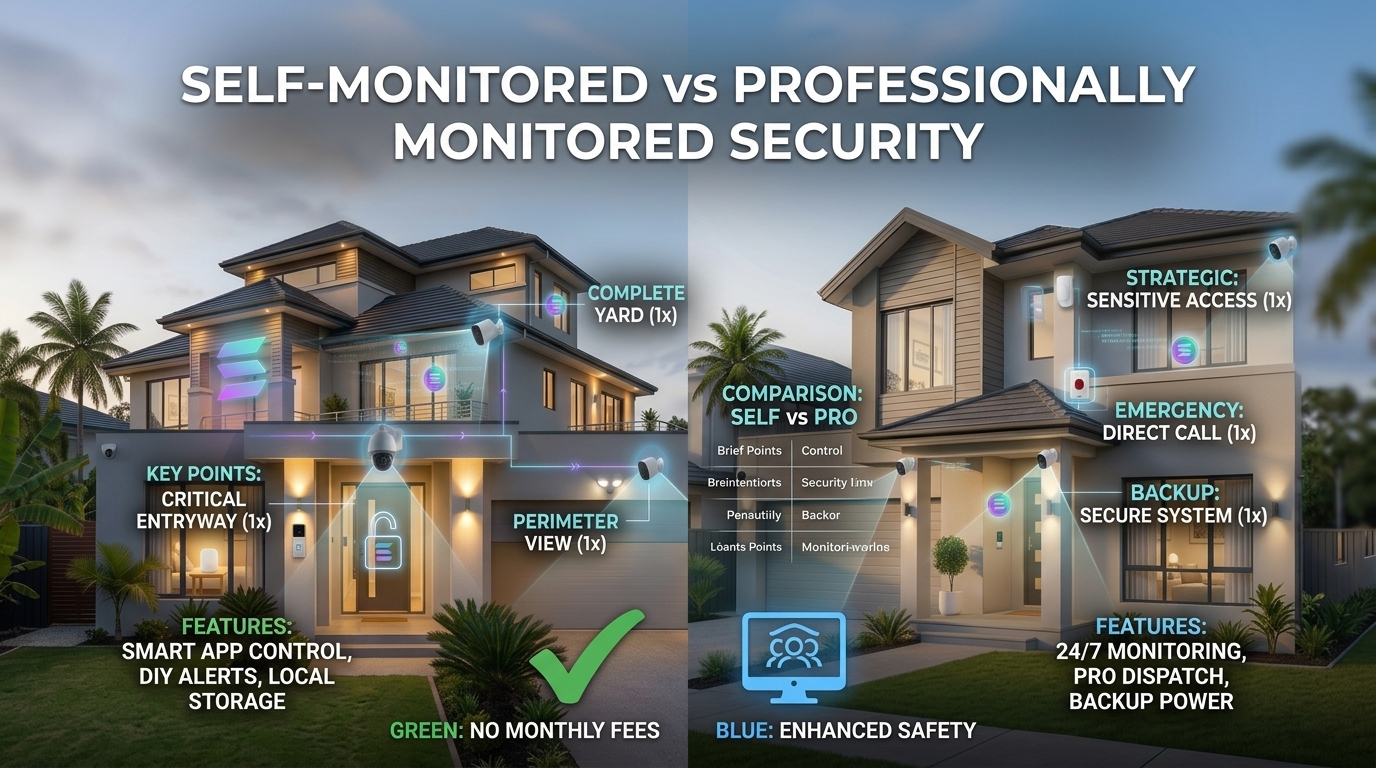
Self-monitoring sends every alert straight to your phone and puts you in charge of deciding what to do, including calling emergency services yourself if something is actually wrong. Professional monitoring routes alerts to a staffed monitoring center instead, where a trained operator verifies the alert and can contact emergency services on your behalf, even if you never see your phone at all. Self-monitoring is generally free or low cost. Professional monitoring adds a recurring fee on top of it. The right fit depends less on the technology, both can run on the same cameras and sensors, and more on your actual life: how reachable you really are, whether anyone vulnerable is often home alone, and whether you want a human safety net behind your own attention.
That is the core decision. The rest of this guide walks through what actually happens when an alert fires under each option, the cost shape without inventing specific numbers, and a short set of questions that tend to settle this for most households.
What actually happens when an alert fires, side by side
With a self-monitored setup, a motion or intrusion alert goes straight to an app on your phone, usually with a photo or short video clip. You look at it, decide whether it is your dog, a delivery, or something worth acting on, and if it is serious, you are the one who calls 911. Nothing happens automatically beyond the notification itself.
With professional monitoring, the same alert first goes to a monitoring center. A trained operator reviews it, and depending on the service, may attempt to reach you by phone to verify before contacting emergency services, or may contact emergency services directly for a verified alarm event. The key difference is that a human is watching for you, continuously, whether or not you personally see your phone in that moment.
Neither approach changes what your cameras or sensors detect. The difference is entirely in who acts on what they detect, and how fast that can happen if you are unreachable.
Cost shape (no dollar figures, no plan comparison)
We will not quote specific prices here, since plans and providers change constantly and vary by region and by feature tier. But the shape of the cost is worth understanding.
Self-monitoring is generally free or close to it, since you are simply using the manufacturer's app to view alerts you already own the hardware to generate. Professional monitoring adds a recurring monthly fee on top of whatever hardware you already have, and that fee typically scales with how much service is included, basic alarm dispatch versus a fuller package with medical alerts or cellular backup, for example.
The honest summary: self-monitoring costs you attention. Professional monitoring costs you money in exchange for reducing how much attention you personally have to provide.
Questions that actually decide this for you
Instead of a features table, these questions tend to point most households toward one option without needing a spreadsheet.
Are you often unreachable for stretches of time? Long work shifts with no phone access, frequent travel to places with unreliable signal, or simply being a heavy sleeper who does not wake to notifications all weaken the case for relying entirely on yourself as the alert responder.
Is anyone vulnerable often home alone? An elderly parent, a child old enough to be briefly alone, or anyone with a medical condition changes the stakes of a missed alert. A monitored system's continuous coverage matters more when the person the alert is protecting cannot necessarily act on it themselves.
Is your home often empty for extended periods? A vacation home, a property you travel away from often, or long stretches with nobody present raise the cost of a missed self-monitored alert, since there is nobody nearby to notice the phone buzzing anyway.
Would a 2am alert actually wake you and get acted on? Be honest about this one. If the answer is no, a self-monitored system is only as good as your worst night of sleep.
If most of your answers point toward "yes, I am reachable, this is my primary home, someone capable is usually present," self-monitoring is a legitimate, complete choice, not a lesser one. If several answers point the other way, professional monitoring is solving a real gap, not just selling peace of mind. Either way, monitoring only matters once there is something worth monitoring in the first place, which is why the research on whether cameras actually deter burglars is worth reading alongside this decision, not instead of it.
What self-monitoring cannot do
A self-monitored system cannot verify an alarm on your behalf, cannot guarantee dispatch if you miss the notification, and gives you no fallback if your phone is dead, silenced, or simply not in your pocket when it matters. It is a complete system for someone who is reliably reachable, not a lesser version of a monitored one.
What professional monitoring adds, and what it does not fix
Professional monitoring adds a continuously staffed layer that does not depend on your attention. What it does not fix is a poorly designed system underneath it. A monitoring center only knows what your sensors and cameras actually tell it. If a camera has a blind spot, or a door sensor is misaligned, or your internet connection is unreliable, paying for monitoring does not correct any of that. The service is only as good as the system feeding it, which is worth revisiting using our guide to how many security cameras you actually need before deciding monitoring alone will cover a gap in coverage.
A middle path exists
Between fully self-monitored and a full professional contract, many systems offer on-demand or no-contract monitoring add-ons that can be turned on for a specific stretch, a vacation, a period of travel, without naming any specific provider here, since which options exist and what they cost changes often enough that a general claim would go stale. If your situation shifts seasonally, more travel in summer, for example, it is worth checking whether your specific system offers that flexibility rather than assuming it is all-or-nothing. This is also the reason our build guide to a smart home security system with no monthly fee treats self-monitoring as the default, with monitoring layered on later as an optional add-on rather than a starting requirement.
FAQ
Is professional monitoring worth the recurring fee? It depends on your situation more than on the technology. Households that are frequently unreachable, have a vulnerable person often home alone, or leave the property empty for stretches tend to get real value from continuous monitoring. Households that are reliably present and reachable often do just as well self-monitoring for free.
Can I switch between self-monitoring and professional monitoring later? On most systems, yes, since the underlying cameras and sensors do not change, only who receives and acts on the alert. Confirm this with your specific hardware and app, since it varies by manufacturer.
Does professional monitoring call the police for me automatically? Typically the monitoring center verifies the alarm first, sometimes by attempting to reach you, before contacting emergency services, rather than dispatching instantly on every alert. This reduces false-alarm dispatches, which is part of what the fee is paying for.
Is self-monitoring safe enough for a full-time occupied home? For a home where someone reachable is present most of the time, self-monitoring is a complete, legitimate choice, not a compromise. The gap it leaves is specifically around unreachability and unattended vulnerability, not about whether the technology itself is capable.
What is the actual difference between the two, in one sentence? Self-monitoring means you are the responder; professional monitoring means a staffed service is the responder, for a recurring fee, whether or not you personally see the alert.

I’m John Smith, the founder of Homegadgetguru.com. I use my IT background to extensively test home automation setups in my own house, giving you the hands-on, practical advice you need to build a smarter, more connected home.