
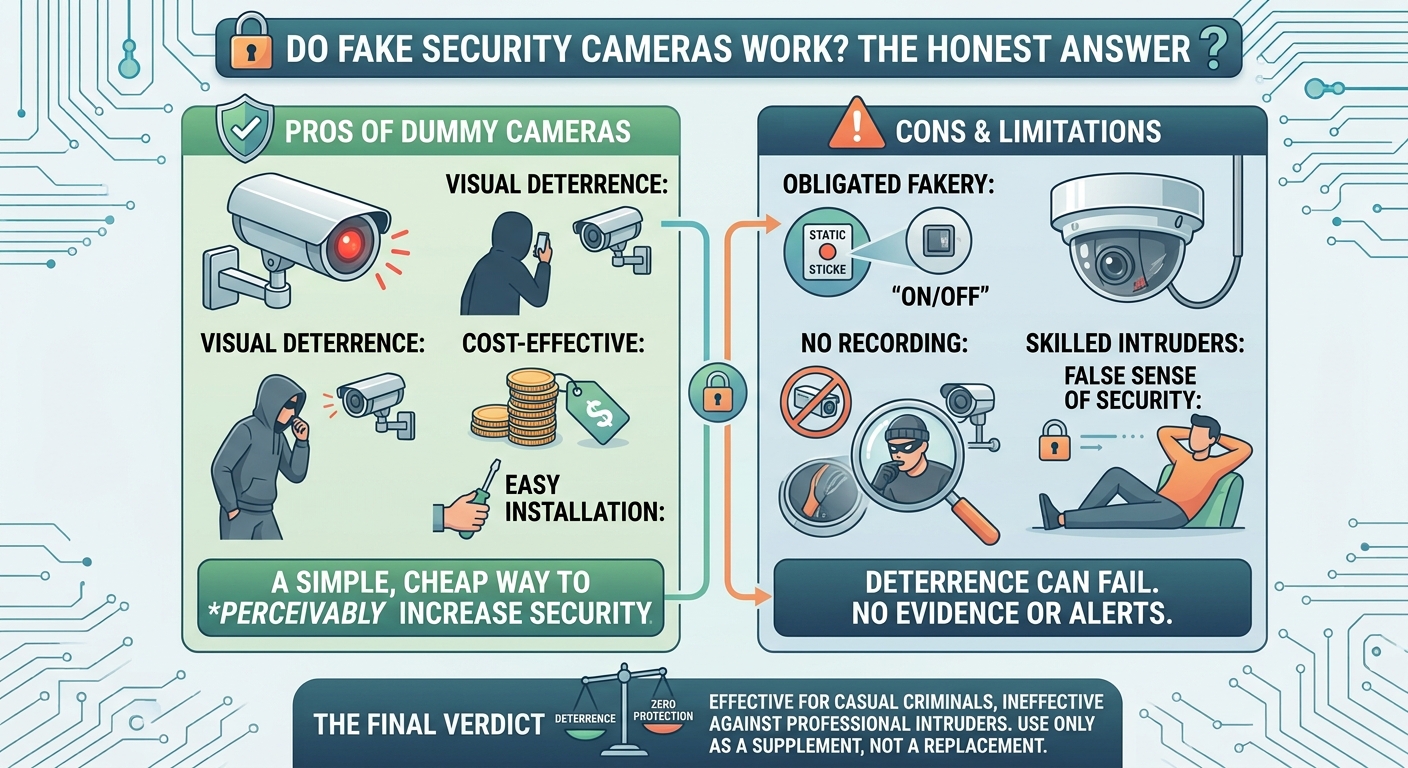
Security signs and dummy cameras provide some real deterrence against opportunistic offenders looking for an easy target. They are less reliable against a more experienced offender, who can often spot a decoy from cheap materials, a missing cable, or no motion at all, and a spotted fake can undermine the deterrent value of any real security nearby. Real or not, a visible camera is a low-cost addition to a layered security plan, not a substitute for one.
This site's guide to whether security cameras actually deter burglars is the fuller research answer on deterrence generally. This piece answers one narrower question: do the fakes specifically hold up.
What Actually Deters an Opportunistic Offender
The research on camera and signage deterrence, covered in full in this site's guide to whether security cameras actually deter burglars, consistently finds that the effect is strongest against opportunistic offenders: someone scanning a street for an easy target, weighing several houses against each other in a short window of time, rather than someone who has already decided a specific home is the target regardless of what they see.
That distinction matters just as much for signs and dummy cameras as it does for real ones. An opportunistic offender is reacting to visible risk signals, not verifying that a device works or that a company on a sign is real. A visible camera-shaped object, or a sign referencing security monitoring, can produce some of that same reaction, because the decision to move on to an easier house often happens quickly and based on appearance rather than close inspection.
Why a Spotted Fake Can Do More Harm Than No Camera at All
Here is the part most sellers of dummy cameras will not tell you. A fake that gets noticed as fake does not just fail to deter. It can actively signal that a property has no real security at all, since an offender who takes the time to identify one fake device has a reason to wonder whether everything else on the property is equally hollow.
The signs of a fake are not subtle to someone who has looked at real cameras before: cheap plastic housing, a blinking light that never varies, no visible cable running to a mounting point where one would be expected on a wired-looking model, or no reaction at all when someone waves a hand in front of the lens. A careful offender who spots even one of these signs may conclude, rightly or wrongly, that the whole property is under-protected, which is a worse outcome than if there had been no camera-shaped object there to notice in the first place.
Signs Specifically: What the Research Says, and What to Be Careful Citing
Security signage shows up constantly in this research area, almost always attached to one specific, widely repeated figure: that a fixed percentage of burglars, commonly cited as somewhere around a quarter, say a sign alone would make them walk away from a property. That number is repeated across an enormous number of security-industry blogs and articles, nearly always tracing back secondhand to a survey connected to the University of North Carolina at Charlotte, and almost never linked to the original study itself, its authors, or its exact methodology.
That pattern, a specific number repeated everywhere and sourced almost nowhere, is exactly the kind of figure this site declines to repeat without being able to trace it to something checkable. The honest version is qualitative rather than a specific percentage: signage has some documented deterrent value against opportunistic offenders in survey research of convicted burglars, generally understood to be less than the effect of a visible, real camera, without a precise, verifiable number attached here. If you see a specific percentage cited elsewhere for signage deterrence, it is worth checking whether that source links to the actual original study or is itself repeating the same secondhand figure.
Where a Dummy Camera Might Make Sense, and Where It Doesn't
A dummy camera is not a straightforwardly good or bad idea; it depends on what it is being asked to do. It can make sense as a low-cost supplement in a spot where a real camera is not currently practical, a detached shed, a rarely used side entrance, or a temporary rental situation, provided it looks reasonably convincing and is not the only security measure on the property.
It makes less sense as a primary security measure for a main entry point, a garage, or anywhere a determined offender is more likely than an opportunistic one, since it offers no evidence, no alert, and no actual barrier if someone does attempt entry, and a spotted fake in a high-value location can do the reputational harm described above. It also makes less sense as a way to save money on the areas of a home that matter most, since the cost difference between a basic real camera and a convincing dummy is often smaller than people assume.
How This Connects to Package Theft and Camera-Count Decisions
A visible camera or sign, real or not, often comes up specifically in the context of package theft, since a delivered box sitting on a porch is a common opportunistic target. This site's guide to how to stop package theft without buying a whole security system ranks the options that actually work for that specific problem, and a visible camera is one meaningful layer among several, not the whole answer on its own.
The decision between a real camera and a decoy also intersects with a more basic coverage question: how many cameras a home actually needs in the first place, and where. This site's guide to how many security cameras a home actually needs walks through counting real entry points and blind spots, which is a more useful starting point than deciding device-by-device whether each one should be real or fake. For a fuller build plan that starts from scratch, this site's guide to a smart home security system with no monthly fee covers the layered approach a sign or a dummy camera fits into as a low-cost supplement, not a replacement.
FAQ
Do dummy cameras actually deter burglars? They can, mainly against opportunistic offenders reacting to visible risk rather than verifying whether a device is real. They are less reliable against a more experienced or determined offender who can often spot a fake.
Is it true that security signs deter about 25 percent of burglars? That figure circulates constantly but is almost always cited secondhand, without a traceable link to the original study, its authors, or its methodology. The honest, sourced statement is qualitative: signage has some documented deterrent value against opportunistic offenders, without a specific verified percentage attached here.
What happens if someone realizes my camera is fake? A spotted fake does not just fail to deter. It can suggest the rest of the property is also under-protected, which can undermine the deterrent value of any real security measures nearby.
Are dummy cameras worth the money compared to a real camera? It depends on the location. They can make sense as a low-cost supplement somewhere a real camera is not currently practical. For a main entry point or anywhere a determined offender is more likely, the cost difference from a basic real camera is often smaller than expected, and a real camera offers evidence and alerts a decoy cannot.
Should I rely on a sign or dummy camera instead of a real security setup? No. Signs and dummy cameras work best as a low-cost supplement to real measures, not a replacement for them. A layered approach, covered in this site's guide to building a security system, gives a more complete picture of where a sign or decoy actually fits.

I’m John Smith, the founder of Homegadgetguru.com. I use my IT background to extensively test home automation setups in my own house, giving you the hands-on, practical advice you need to build a smarter, more connected home.