
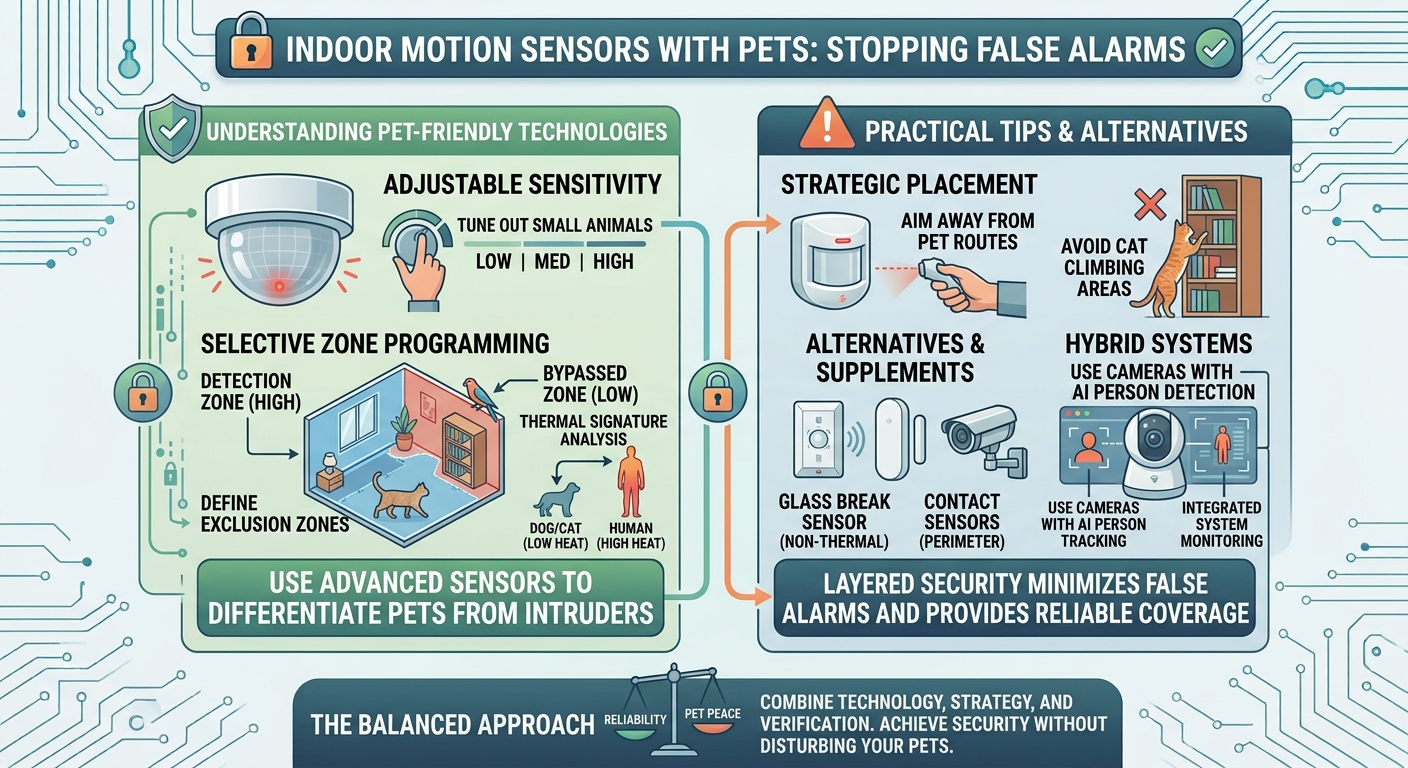
Most pet-triggered false alarms come from placement and mounting height, not a faulty sensor. Standard passive infrared (PIR) motion sensors read heat and movement in a cone-shaped zone, and if that zone reaches down to floor level, a cat jumping onto a windowsill or a dog walking under it will trigger it regardless of how "pet-immune" the label says the sensor is. The fix is mounting height, aim, and choosing a sensor with a genuine pet-immunity rating that matches your pet's size, not just the phrase "pet friendly" on the box. This guide covers each of those in order, so the alarm stops firing at your own dog without you having to disable it entirely.
Why "pet immune" is a specification, not a guarantee
It's worth being precise about what pet-immune motion sensors actually do, because the marketing term oversells it slightly. These sensors use dual-element PIR detection combined with an algorithm that weighs the size, height, and movement pattern of a heat signature, and they're rated to ignore animals up to a certain weight, commonly somewhere in the 40 to 80-pound range depending on the specific model. Two things matter here: first, that weight rating varies by manufacturer and model, so check the actual spec sheet for the sensor you're buying rather than assuming a general "pet immune" label covers your particular dog. Second, even a correctly rated sensor can still be fooled by placement. If a pet gets close enough to the sensor, commonly cited as within about six feet, or climbs onto furniture that puts it near the sensor's field of view, many pet-immune sensors will trigger anyway, regardless of the pet's weight rating.
Placement fixes that actually work
Mounting height and downward aim
Motion sensors are commonly recommended to sit around four to five feet off the ground, aimed so the detection cone covers the upper half of a room rather than sweeping down to the floor. A sensor mounted too low, or aimed too flat, extends its detection zone into the exact height range where a dog or cat spends all of its time. Raising the mount and angling it to favor the space a standing adult occupies, rather than the space a pet occupies, is the single most effective fix most households can make without buying anything new.
Keep furniture out of the sensor's near field
A couch, cat tree, windowsill, or stack of boxes positioned close to a motion sensor gives a pet a launch point that puts it well within range, even from a well-mounted sensor. Rearranging so nothing climbable sits within roughly six feet of the sensor's direct line of sight closes this gap without touching the sensor itself.
Check the stairs
A sensor with a view down a stairwell a pet can climb is a common, easy-to-miss source of false alarms, since the sensor sees the pet moving through open space at multiple heights as it goes up or down. If a stairwell is in view, either reposition the sensor or accept that it will need to be disarmed in that zone whenever the pet has access.
Use zones, not a full-house sweep
If your system supports zoning, exclude rooms your pet has free access to from the armed set, or arm those zones only when the pet is contained elsewhere, such as overnight in a crate or a closed room. This is a configuration choice, not a workaround; it lets the rest of the system stay fully armed while acknowledging that one room's motion history is dominated by an animal, not an intruder.
When to consider a different sensor instead
If placement and zoning still aren't enough, especially for a larger dog or a household with multiple pets moving through shared spaces, a sensor with a higher-rated pet immunity threshold, or a curtain-style sensor that only detects motion crossing a narrow, precisely aimed beam rather than a wide cone, is worth the upgrade over continuing to fight placement. This is also the point where it's reasonable to accept that certain rooms simply aren't good candidates for motion coverage with pets present, and to lean more heavily on door and window sensors for those areas instead. Our guide to door and window sensors covers where that type of sensor does a job motion detection can't, and if you're weighing motion detection against glass-break detection for the same room, our comparison of glass break sensors vs motion sensors covers which gap each one actually closes.
This is the same underlying problem cameras have, solved differently
If you've already dealt with a camera that fires constant notifications at your own pet, the diagnosis is similar: it's almost always placement and detection zone, not a broken device. Our guide to cutting security camera false motion alerts walks through the camera-side version of this same fix, including smart detection settings that filter for people rather than any movement.
Where this fits into a full system
Motion sensors are one layer of a larger setup, and pet-proofing them shouldn't come at the cost of leaving other layers, like door and window contacts or cameras at entry points, thinner than they need to be. If you're building or rebalancing your system from scratch, our pillar guide to a smart home security system without a monthly fee walks through how motion sensors fit alongside the rest.
A short placement checklist
- Mount motion sensors roughly four to five feet up, aimed to cover the upper half of the room.
- Keep furniture, cat trees, and anything climbable at least six feet from the sensor's direct line of sight.
- Check whether a stairwell sits in the sensor's view, and reposition if it does.
- Use zoning to exclude or schedule rooms your pet has free run of, rather than disabling the whole system.
- Check the sensor's actual pet-immunity weight rating against your specific pet before buying, not just the "pet friendly" label.
- If placement fixes don't hold, consider a higher-rated or curtain-style sensor rather than living with constant false alarms.
FAQ
What weight of pet will trigger a "pet immune" motion sensor? It depends on the model. Many pet-immune sensors are rated to ignore animals up to somewhere between 40 and 80 pounds, but that threshold varies by manufacturer, so check the specific product's spec sheet against your pet's actual weight rather than assuming the label applies universally.
How high should I mount a motion sensor to avoid triggering on my dog? Roughly four to five feet is the commonly recommended range, aimed to favor the upper half of the room rather than sweeping down toward floor level, where a pet spends nearly all of its time.
Can my cat still trigger the sensor even if it's rated pet-immune? Yes, if the cat gets close enough to the sensor, commonly within about six feet, or climbs onto furniture positioned near the sensor's field of view. Pet immunity is about weight-based filtering, not distance, so a nearby cat can still register as motion regardless of its size.
Should I just turn off motion detection in rooms my pet uses? That's a reasonable option if placement fixes aren't enough, and it's better handled through zoning, if your system supports it, than by disabling the whole system. This lets other zones stay armed while acknowledging that one pet-occupied room isn't a reliable place for motion-based detection.
Is a curtain-style sensor better than a standard PIR sensor for a home with pets? It can be, since curtain-style sensors detect motion crossing a narrow, precisely aimed beam rather than a wide cone, making it easier to set a detection line above where a pet moves. It's a reasonable upgrade if placement and zoning on a standard sensor still aren't solving false alarms.

I’m John Smith, the founder of Homegadgetguru.com. I use my IT background to extensively test home automation setups in my own house, giving you the hands-on, practical advice you need to build a smarter, more connected home.