
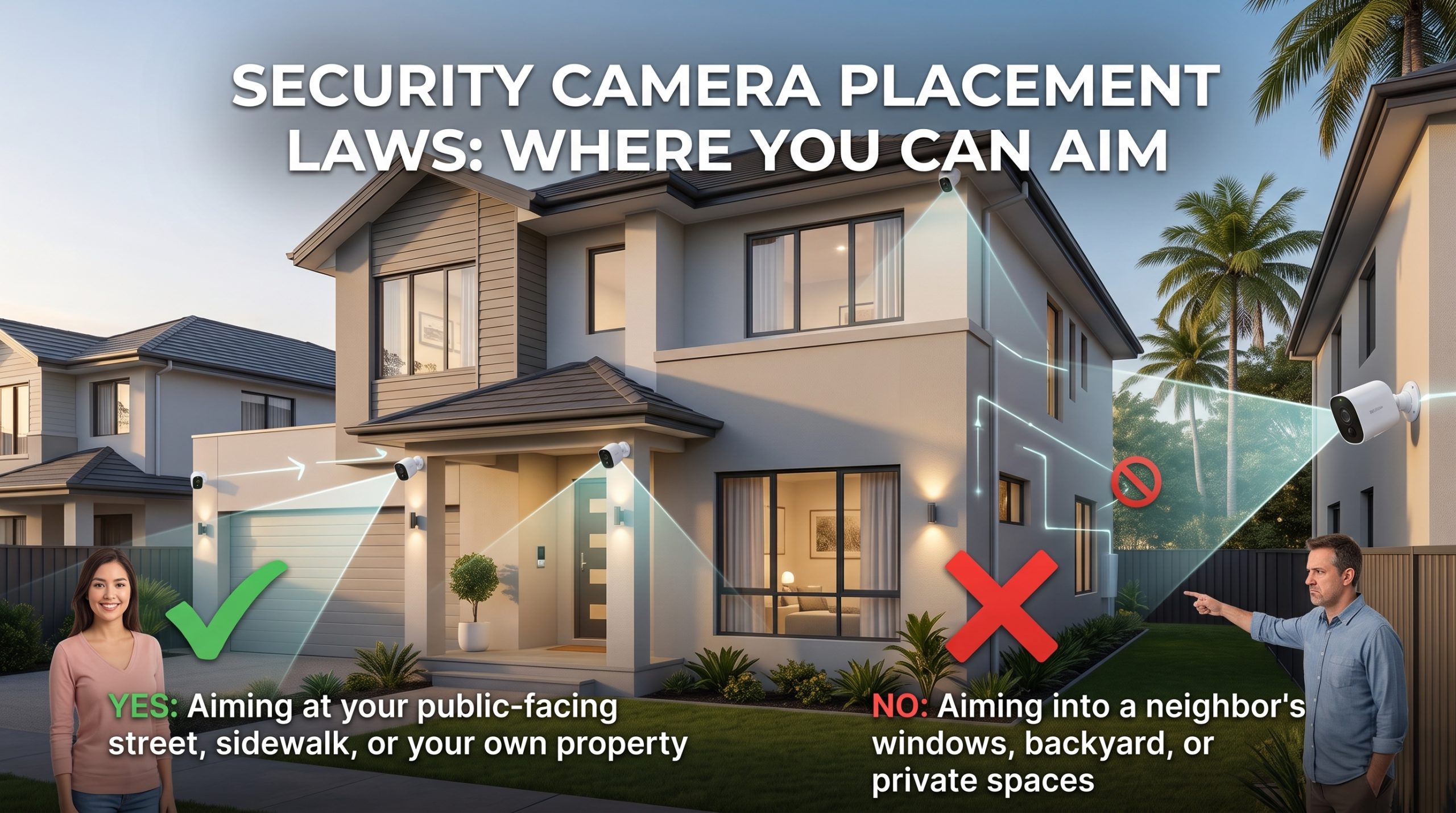
You can record areas you own that are visible from public space, like your driveway, front yard, porch, and doorway. You cannot aim a camera into a neighbor's windows or into a fenced, clearly private area, and cameras are never allowed in bathrooms or bedrooms, even in your own home. The legal test behind all of it is a "reasonable expectation of privacy." Audio is the bigger trap: recording sound is regulated more strictly than video, and some states require everyone's consent, so it is safest to leave audio off unless you know your local rules. This is general information, not legal advice.
That last line matters, so we will say it up front and keep saying it. Camera and recording laws vary by country, by US state, and sometimes by city. This guide explains the widely shared principles and the questions to ask. It cannot replace your own state and local rules, and for a real dispute you should check those rules or talk to a lawyer.
The one idea behind every camera rule: reasonable expectation of privacy
Almost every home camera question comes back to a single legal concept: a "reasonable expectation of privacy." The rough idea, reflected across US privacy law, is that people accept they can be seen in public or from public view, but they expect privacy in certain places and situations. A person standing on a public sidewalk has little expectation of privacy. That same person inside their own bathroom or changing in their bedroom has a very high one.
For a homeowner putting up cameras, this translates into a simple working rule. Filming your own property and the public-facing space around it is generally fine. Filming into someone else's private space, or into a space where anyone would reasonably expect to be unseen, is where you cross a line. You do not need to memorize statutes to use this test. You just have to ask, before you mount a camera: would a reasonable person in this spot expect privacy?
Where to place cameras for real coverage
Good placement is a security question first, so start there. The spots that actually reduce risk are the ones burglars use and the ones where packages and cars sit.
- Front door and porch. Most break-ins and the majority of package thefts happen at or near the front entrance. A doorbell camera or a camera covering the porch earns its place.
- Driveway and garage. Covers vehicles, the side approach, and anyone walking up.
- Back and side doors. These are the quiet entry points that people forget, which is exactly why intruders like them.
- First-floor windows that are easy to reach. A wide camera covering that side of the house is often enough.
- Main indoor common areas, like an entry hallway or a living room facing the door, if you want an inside layer.
Mount cameras high enough to be out of easy reach, angle them to capture faces rather than the tops of heads, and avoid pointing them straight into bright light. If you are still deciding between hardwired units and battery models for these spots, our guide to wired vs wireless security cameras walks through which type fits which location.
What you may record
On your own property, you have wide latitude for video. Across the US it is generally legal to record video of:
- Your own yard, driveway, porch, and the exterior of your home.
- The public street or sidewalk that is visible from your property. Public space carries little expectation of privacy, which is why a doorbell camera catching passersby is normally fine.
- Your own home's interior common areas, like a hallway, living room, or kitchen.
- Shared spaces you are entitled to monitor, within the limits below.
The theme is consistent: if it is your space, or it is public and simply visible from your space, video is usually allowed. The complications start at the edges of your property and inside private rooms.
What you may not record
Some places are effectively off-limits no matter who owns the camera:
- Bathrooms and bedrooms, always. Even in your own home, these are the clearest examples of spaces where people expect privacy. Point a camera into one, especially where a guest, tenant, or houseguest undresses or sleeps, and you have moved from "home security" into territory that can carry serious legal consequences.
- A neighbor's windows or the inside of their home. Deliberately framing your camera to see through a neighbor's window is one of the fastest ways to invite a privacy complaint or a lawsuit.
- A neighbor's fenced or enclosed private area. A fenced backyard signals an expectation of privacy. Aiming a camera to peer over or into it is the classic dispute.
- Hidden cameras in private spaces. Concealed recording in areas where people expect privacy is treated far more harshly than an obvious, visible camera.
A camera that happens to catch a slice of the street or a neighbor's front yard in the background is different from one positioned to surveil a neighbor's private life. Intent and framing matter. When in doubt, adjust the angle so your coverage stops at your property line, and use privacy-zone masking if your camera offers it.
The audio trap: why sound is riskier than video
This is the section most placement guides skim, and it is the one that gets ordinary homeowners in trouble. Audio recording is regulated separately from, and more strictly than, video.
Federal wiretap law, part of the Electronic Communications Privacy Act, sets a one-party-consent baseline for recording conversations, meaning at least one person in the conversation must consent. Many states match that one-party standard. But a number of states go further and require that everyone being recorded consents. These are usually called all-party or two-party consent states.
As reported in recent state-law summaries, roughly a dozen states fall into the all-party consent camp. Commonly cited examples include California, Florida, Illinois, Maryland, Massachusetts, Pennsylvania, and Washington, among others. The exact list and its finer points shift over time and vary in how they treat in-person versus phone conversations, so treat those names as examples, not a complete or final list, and confirm your own state before you rely on any of them.
Here is why this bites homeowners. A doorbell or outdoor camera that records audio can pick up conversations happening on the sidewalk or a neighbor's porch. In an all-party consent state, capturing that conversation without consent can run afoul of wiretapping law, which is a much heavier problem than a video framing dispute. The safest default for most home setups is simple: leave audio recording off unless you have a specific reason for it and you have confirmed what your state requires. Many cameras let you disable the microphone independently of video, and doing so removes the riskiest part of the whole setup.
"It's my house" does not cover everyone in it
A common assumption is that owning the home settles the question. It does not, because the privacy test attaches to the people being recorded, not only to who holds the deed.
- Guests and houseguests still expect privacy in a bathroom or a guest bedroom. Owning the house does not give you a right to record them there.
- Tenants and renters have strong privacy protections. Landlords generally may place cameras in shared common areas of a building, like a lobby, hallway, or parking lot, but placing a camera inside a tenant's unit, or in a bathroom or bedroom, is almost always off-limits without clear consent. If you rent out a room or a unit, this applies to you.
- If you are the renter, you usually can add your own cameras for your own space, but check your lease, avoid drilling that violates it, and never point a camera into a shared area in a way that surveils other residents.
The short version: the same reasonable-expectation-of-privacy line that protects your neighbor also protects anyone living in or visiting your home.
HOA, landlord, and workplace rules stack on top of the law
Even when the law allows a camera, a private rulebook can still restrict it. These rules sit on top of the legal principles above, not instead of them.
- HOAs frequently require you to request approval before mounting exterior cameras, and may set rules on appearance and placement. An HOA can regulate its own community cameras too, but it still cannot point them into spaces where residents expect privacy.
- Landlords set what tenants may install, and tenants set nothing that overrides a landlord's own lawful common-area monitoring. Read the lease.
- Workplaces, including a home office where you employ someone like a nanny or cleaner, add another layer, and audio in particular gets sensitive fast.
None of these private rules can make an illegal recording legal, and none of them replace your state law. They are extra hurdles, not shortcuts.
Safe-placement quick reference
| Spot | Good idea? | Watch out for |
|---|---|---|
| Front door / porch | Yes | Keep the frame on your property, not the neighbor's door |
| Driveway / garage | Yes | Avoid deliberately capturing a neighbor's yard |
| Back and side doors | Yes | Mount high, angle for faces |
| Street-facing view | Usually fine | Fine to see public space; do not zoom into windows |
| Indoor common areas | Yes | Disclose to guests and household members |
| Bathroom / bedroom | No, ever | Off-limits even in your own home |
| Pointed at neighbor's window or fenced yard | No | Reasonable-expectation-of-privacy violation |
| Any camera with audio on | Caution | Confirm one-party vs all-party consent first |
Because privacy is the thread running through camera placement and camera recording alike, it is also worth deciding where your footage lives. Our comparison of local vs cloud camera storage covers who can access your recordings under each option. For the full picture on building a system without a subscription, start with our pillar guide to a smart home security system with no monthly fee.
FAQ
Can I point a security camera at the street or sidewalk?
Generally yes. Public spaces like streets and sidewalks carry little expectation of privacy, so a camera that captures them, including a doorbell camera catching passersby, is normally allowed. The problem starts if you use zoom or angle to surveil a specific neighbor's private space rather than simply covering the public view.
Is it legal to record audio on my home security camera?
It depends on your state, and audio is stricter than video. Federal law uses a one-party-consent baseline, but roughly a dozen states require all parties to consent to a recorded conversation. Because a camera can pick up sidewalk or porch conversations, the safest default is to turn audio off unless you have confirmed your state's rule and have a specific reason to record sound.
Can my neighbor point their camera at my house?
Often a camera that incidentally includes part of your property in a wider shot is allowed, since you can be seen from public view. What is generally not allowed is a camera deliberately aimed to record through your windows or into your fenced private area, which can breach the reasonable-expectation-of-privacy principle. If you believe a neighbor is targeting your private space, document it and check your local rules.
Can a landlord install cameras in a rental?
Landlords can usually place cameras in shared common areas such as hallways, lobbies, and parking lots for security. They generally cannot place cameras inside a tenant's unit or in any private space like a bathroom or bedroom without clear consent, and hidden cameras in private areas are treated very seriously. Rules vary by state, so both landlords and tenants should confirm local law.
Do I need HOA approval for a security camera?
Possibly. Many HOAs require homeowners to request approval before installing exterior cameras and may set placement or appearance rules. HOA approval does not override privacy law, and the HOA's own cameras still cannot be pointed into private spaces. Check your community's governing documents before you mount anything.
This article is general information about widely shared privacy principles in the United States. It is not legal advice, and these laws are set state by state, with some cities adding their own rules on top. For a specific situation or dispute, confirm your own state and local rules or consult a qualified attorney.

I’m John Smith, the founder of Homegadgetguru.com. I use my IT background to extensively test home automation setups in my own house, giving you the hands-on, practical advice you need to build a smarter, more connected home.