
The short answer
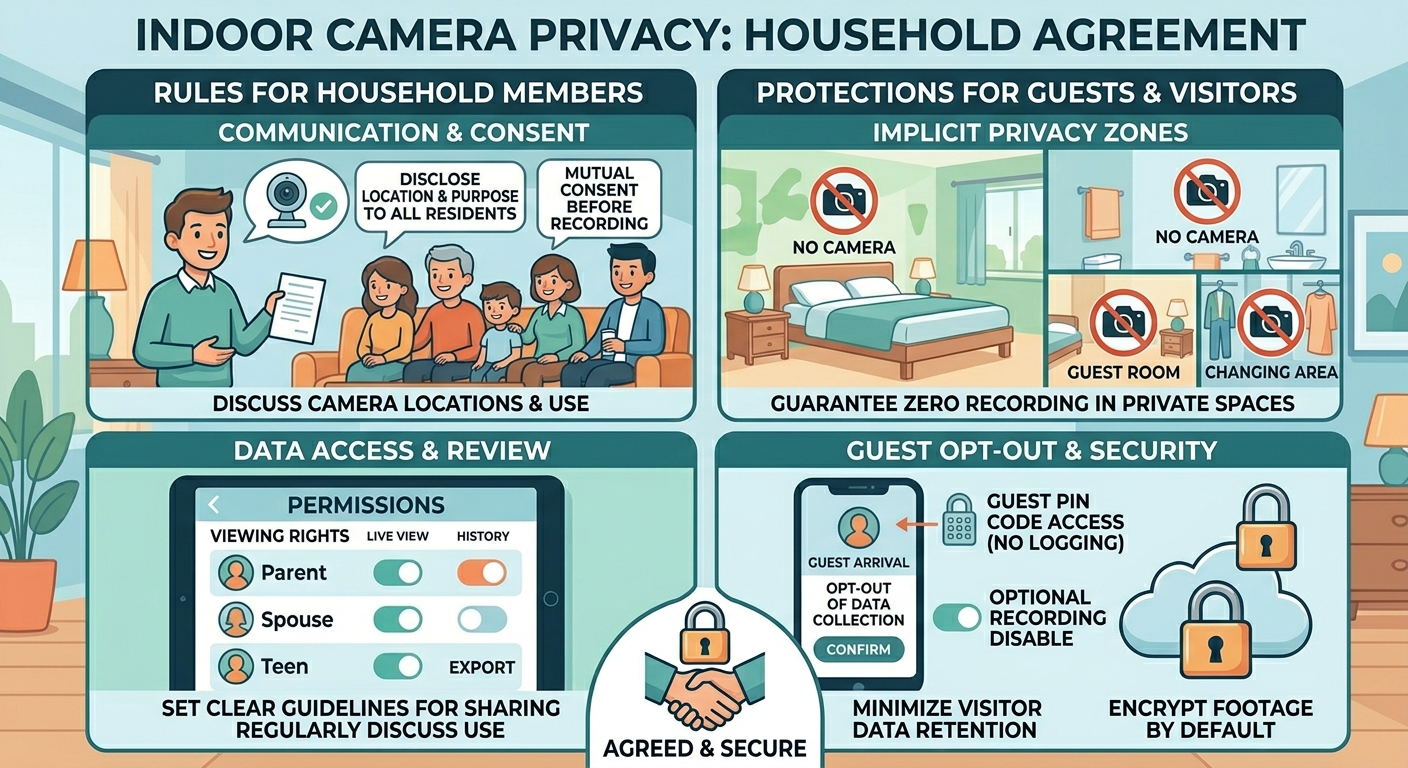
Inside a home, the clearest rule is that bedrooms and bathrooms stay camera-free, regardless of what's technically legal, because those are spaces where every household member expects privacy. Shared spaces like a living room or kitchen are the more common, less contentious placements. The harder questions are usually about people, not rooms: how camera use should change as children get older, and what a guest or live-in family member should be told.
Telling people a camera exists, rather than not mentioning it, is consistently the better default.
This piece stays inside the household: which rooms, and which people, an indoor camera decision actually involves. It does not cover the legal question of what is recordable outside the home, neighbors, or property lines; that is a separate topic this site covers elsewhere and links to below.
The rooms that stay camera-free, and why that's nearly universal advice
Bedrooms and bathrooms are the one placement question with close to universal agreement, independent of what a given jurisdiction technically permits. These are the spaces where every household member, including the person who owns the camera system, reasonably expects not to be observed, and installing a camera there tends to damage trust regardless of the stated intent behind it. This is a household-agreement point, not a legal one: a camera can be entirely permitted in a given room and still be a bad idea inside your own home, because legality and household trust are answering two different questions.
Shared spaces, a living room, kitchen, entryway, or hallway, are the far more common and less contentious placements, since they are already visible to everyone who lives in or visits the home during ordinary daily life. A camera in a shared space is not adding new visibility so much as recording visibility that already exists; a camera in a bedroom or bathroom is adding a kind of observation that did not exist before, and that distinction is why the two categories of room are treated so differently here.
Cameras and children: what changes as they get older
The right answer to "is a camera in a child's space acceptable" changes meaningfully with age, and treating it as one fixed rule misses that. For a baby or a very young child, a camera in a shared space of their room is a common and widely accepted use, generally framed around supervision rather than surveillance. As a child grows into the age where they have a developing sense of privacy and can meaningfully understand what a camera does, the calculation shifts: continuing to monitor a room the way you did when they were an infant starts to read differently to the child, and often to the parent too.
There is no single age where this switches over for every family, and this piece does not claim one. What matters more than picking an exact cutoff is revisiting the decision periodically rather than leaving a childhood-era camera setup running unchanged and unquestioned for years, and being willing to have the conversation directly with an older child about what is being watched and why, the same conversation this piece recommends for any household member.
Cameras and guests, a cleaner, or a live-in family member
A guest, a cleaner, or a live-in family member each raises a slightly different version of the same underlying question: does this person know a camera exists in the spaces they will be in, and have they had a reasonable chance to react to that before they are actually in front of it. A short-term guest staying in a shared space benefits from a simple, direct mention before they arrive or as they walk in, not a buried line in a house-rules document they are unlikely to read closely.
A cleaner or another recurring service provider is in the home regularly enough that this becomes an ongoing relationship rather than a one-time notice, and it is worth being consistent about which rooms are covered and which are not; the same camera-free boundary that applies to bedrooms and bathrooms for the household applies for anyone else in the home too. A live-in family member, a parent, an adult child, or another relative sharing the household long-term, is the case that most benefits from an explicit, ongoing conversation rather than a one-time disclosure, since their daily life in the home is the most affected by any camera in a shared space.
Telling people a camera is there, and why that's the better default
Across every scenario in this piece, telling people a camera exists is consistently the better default over not mentioning it, even in situations where doing so is not strictly required. A camera someone does not know about, discovered later, tends to damage trust more than the fact of the camera itself would have, and that damage is disproportionate to whatever the camera was actually there to accomplish. A simple, direct mention, this room has a camera, here is roughly why, costs very little and removes most of the tension a hidden or unmentioned camera creates.
This does not mean every household needs a formal written policy. For most homes, a plain conversation with the people who live there or visit regularly is enough. What matters is that the mention happens before the person is in front of the camera, not after they find out some other way, since the order those two things happen in is a large part of what determines whether the camera feels like a safety feature or a surprise.
Where this differs from the legal question
Everything above is a household-agreement question, not a legal one, and that distinction matters because the two questions can have different answers in the same room. A camera can be entirely legal to place somewhere and still be a poor household decision if it was never discussed with the people it affects; conversely, being careful and communicative about a camera does not by itself answer whether a given placement is legally permitted where you live. This piece deliberately stays on the household side of that line.
For the legal question, specifically what is recordable and where, including anything involving audio consent or space outside the home, this site's separate guide to where you can and can't point a home security camera covers that ground and is the place to go for it rather than restating a legal position here. For where indoor footage actually goes once it is recorded, this site's guide to local vs cloud camera storage is the relevant read, and the network any of that footage travels over in the first place is its own layer worth getting right, which is why this site's guide to securing your home Wi-Fi before you add a single security device is worth reading alongside the household-rules layer this piece covers. If access management for who can enter the home in the first place is also part of your household's setup, guest codes and access logs for smart locks covers the parallel access-control conversation for locks rather than cameras. And for the broader buying decision, this site's guide to a smart home security system with no monthly fee is the pillar this cluster builds from.
FAQ
Are there rooms where an indoor camera should never go? Bedrooms and bathrooms are the rooms with close to universal agreement against camera placement, since these are spaces where every household member reasonably expects privacy, independent of what is technically legal where you live.
At what age should a camera come out of a child's room? There is no single age that applies to every family. What matters more is revisiting the decision periodically as a child develops a sense of privacy, rather than leaving an early-childhood camera setup unchanged for years without discussing it.
Should I tell a cleaner or guest that a camera is recording them? Yes. Telling people a camera exists, before they are in front of it, is consistently the better default across every scenario this piece covers, even in cases where disclosure is not strictly required.
Is it legal to have a camera inside my own home? That is a separate legal question this piece does not answer. This site's guide to where you can and can't point a home security camera covers that ground specifically.
Does a household camera policy need to be written down? Not necessarily. For most homes, a plain, direct conversation with the people who live there or visit regularly accomplishes the same thing a formal policy would, as long as it happens before someone is in front of the camera rather than after.

I’m John Smith, the founder of Homegadgetguru.com. I use my IT background to extensively test home automation setups in my own house, giving you the hands-on, practical advice you need to build a smarter, more connected home.